
MAHA SHIVRATRI – THE ECSTATIC NIGHT OF SHIVA
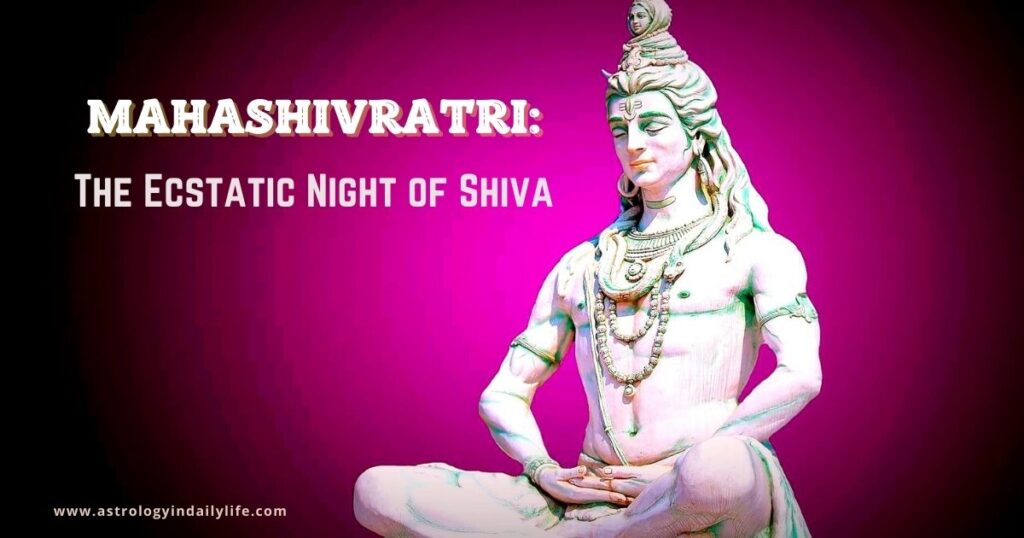
Maha Shivaratri literally means ‘The Great Night of Shiva”. Maha Shivaratri is celebrated in the Hindu month of Phalguna on the 13th lunar night (Trayodashi) transiting to the 14th lunar night (Chaturdasi). On this night, the Sun is in the Aquarius sign while Moon is in the Capricorn sign. The planetary positions are aligned in such a pattern on this auspicious night that it naturally invokes an upsurge of energy in the human structure. Being awake the whole night and meditating on Shiva’s name rejuvenates the devotees – physically, mentally and spiritually. Maha Shivaratri is observed the night before Amavasya i.e. the New Moon. Moon represents the Mind; this Mind keeps attracting and distracting us in different directions. On the 14th lunar night when the Moon’s Energy has its least effect on the Mind, it is an appropriate time to direct our energies inwards. This inward journey quietens and calms the mind and helps us connect to the ‘Shiva Tattva’ – the element of Shiva within us. Shiva is the very energy that administers and regulates the entire creation – within and without us. Maha Shivaratri is a celebration of spiritual significance and a cultural and cosmic event deeply rooted in Hindu mythology and tradition. Legend has it that on this auspicious night, Lord Shiva performed the heavenly dance of creation, preservation, and destruction, known as the Tandava Nritya. This divine dance symbolizes the cosmic cycles of life, death, and rebirth, highlighting the eternal rhythm of the universe. The Secret of remaining awake the whole night: Staying awake throughout the night symbolizes vigilance and awareness. It represents a heightened state of consciousness and mindfulness in which devotees remain fully present and engaged in their spiritual practice, whether through meditation, chanting, or prayer. This vigilance helps ward off ignorance and negative influences, allowing individuals to deepen their connection with the divine. In Hindu philosophy, the night symbolizes Tamas, one of the three Gunas or qualities of nature associated with darkness, ignorance, and inertia. By remaining awake and actively engaging in spiritual practices, devotees strive to overcome the influence of Tamas and cultivate qualities of light, knowledge, and dynamism associated with the other Gunas, namely Rajas and Sattva. According to Ayurveda, Vata imbalance is the root cause of most diseases. A person with balanced Vata is physically and mentally healthy; he is positive, active and calm. Maha Shivaratri is the night to balance the Vata in the body. The energies around us this night are most conducive to aligning the Cosmic Energy to regulate the excessive Vata. Sitting comfortably in Padmasana or Ardha-Sukhasana automatically keeps the spine erect. Performing anulom vilom pranayam – an ancient yogic breathing technique – in this pose helps balance and regulate the Vata energy in the body. Besides, this kriya also purifies the Energy Body – Sukshma Sharir and activates Higher Consciousness. Note: Do not forget to recite the Panchakshari Mantra 108 times after doing the Pranayam. Maha Shivratri Muhurat 2026: Here is the auspicious Muhurat for Maha Shivaratri – 2026 for Mumbai: Maha Shivaratri is on Sunday, February 15, 2026 Nishita Kaal Puja Time – 12:09 AM to 01:01 AM, February 16 What should you do during Maha Shivaratri? Maha Shivaratri is a very auspicious and potent night to start any Mantra Sadhna. It is also a promising time to initiate remedies for the fulfilment of desires or solving of problems. This is also a good occasion to apologize for your wrongdoings and free yourself from any guilt. Here is the list of things you can do on Maha Shivaratri: Start any health-related Mantra recitation such as Maha Mrityunjaya Mantra. This is the best time of the year to start wearing Rudraksha, Pearls and silver ornaments – especially for remedial purposes. If you are already wearing a Rudraksha, please energize it on the day of Shivaratri. It will become ten times more powerful. For childless couples: For the protection of pregnancy and to get a healthy child, the wife should wear Garb Gauri Rudraksha. For early marriage: Eligible boys and girls should wear the ‘Gauri Shankar Rudraksha’ on Mahashivaratri. It is also a good time to install a Parad/Mercury Shivling (for health) or Sphatik/Crystal Shivling (for wealth and prosperity). People with weak Chandra/Moon should perform Mahashivratri Pooja or at least meditate on Lord Shiva on this night. Those troubled by malefic Shani/Saturn or Pitru/Kaal Sarpa/Manglik/ Grahan Dosha should do appropriate remedies on this day. People suffering from Kaal Sarpa Dosh should fast and light up an Akhand Diya (Eternal Lamp) followed by Rudrabhishek. Shiv Aradhana or Shiva Meditation is the most effective and powerful remedy to calm down Rahu and Ketu. A very good remedy for Ketu is the reciting of Shiva Panchakshari Stotra: Na-Ma-Si-Va-Ya. You can read and contemplate on scriptures related to Lord Shiva, such as the Shiva Purana, Linga Purana and Rudram Chamakam, to deepen your understanding and connection with His divine attributes and teachings. You can perform Rudrabhishekam, a special ritual where Lord Shiva’s lingam or idol is bathed with various sacred items like water, milk, yoghurt, honey and ghee while chanting Vedic hymns and mantras dedicated to Lord Shiva. SHIV MANTRAS & THEIR BENEFITS: Basic Shiva Mantra: A very powerful Mantra that enhances your abilities and raises the intellect to the optimum levels. Panchakshara Stotra: The ‘Panchakshara’ literally means “five letters” in Sanskrit and refers to the five holy letters Na, Ma, Śi, Vā and Ya. The human body is made up of five elements and these five letters represent these elements. Na – Prithvi Tattva (Earth element), Ma – Jal Tattva (Water factor) Si – Agni Tattva (Fire
AKSHAYA TRITIYA: NEW BEGINNINGS, PROSPERITY AMPLIFIED

hink you know Akshaya Tritiya? Think again. Uncover the deeper meaning behind this powerful day of cosmic alignment and timeless abundance.
ALL YOU WANTED TO KNOW ABOUT DHANTERAS

DHANTERAS – THE BEGINNING OF DIWALI Deepawali (Deepa-Lamps; Awali-Row) meaning ‘A row of lamps’ is also called Diwali in its shortened version. Diwali is a five-day festival celebrated all over India and also in many other countries across the globe. Each of the five days of Diwali has its own meaning and significance. Dhanteras marks the beginning of the festivities of Diwali. Meaning of Dhan-trayodashi: Trayodashi means “thirteenth day” of the Hindu fortnight and Dhan means “wealth”. Thus, as the name implies, Dhanteras falls on the thirteenth day of Krishna Paksha (Dark Fortnight) in the Hindu month of Kartik. Hence another name for Dhanteras is Dhantrayodashi. People worship Goddess Laxmi and Lord Kuber to bless them with prosperity and well being. What is the Significance of Dhanteras? In the story of Sagar Manthan, it was on this day that Lord Dhanvantari appeared with the nectar urn from the churning ocean. Along with him, jewellery and precious gems also emerged from the ocean. Since then this day was named ‘Dhanteras’ and the tradition of buying utensils and jewellery started. Ayurvedic vaidyas (doctors) consider Lord Dhanwantri as the Father of Ayurveda-the bestower of health and celebrate this day as his birthday. They distribute neem leaves and mishri (candy sugar) as prasad to visitors. Dhan also means Wealth. Undoubtedly, Dhanteras is also very important for businessmen, traders and merchants. Goddess Lakshmi along with Lord Kubera (God of wealth) is worshipped on this day. Dhanteras is also known as the day of “Yama Deep Daan”. Lord Yama (God of Death) is worshipped on this day to provide prosperity and well-being to all and to avert untimely death. Lord Kuber is generally worshipped through the medium of Kuber Yantra. What is done on Dhanteras? The following are the different rituals and traditions followed during Dhanteras: SHOPPING: Dhanteras marks the grand finale of all major Diwali shopping. It is auspicious to purchase a new cooking/eating vessel this day. The new utensil purchased is filled with puffed rice (kheel) and some coins. This vessel is then kept at the place where Lakshmi Pooja is to be done on Diwali night. It is believed that on Diwali night, Lord Dhanwantri will fill this vessel with health, while Lord Kubera will fill it with wealth. 2. OFFERINGS: Different types of offerings are prepared on this day in different regions of India. In Maharashtra, there is a tradition to offer a Naivedya (holy offering) of lightly crushed dry coriander seeds and jaggery. Whole wheat porridge or atte ka halwa or lapsi is prepared and distributed as prasad in parts of North and East India. In most of the households, Panchamrit, a preparation made with honey, curd, milk, ghee and sugar is distributed as prasad. Also, Kheer made from rice, milk and sugar is another favourite offering. 3. YAM DEEP DAAN: In the evening, one a four-faced Diya or thirteen oil lamps made of wheat flour are lit. Devotees keep these lamps outside the house with their flame facing southwards. (This is the only day in the whole year when the lamp’s flame is kept facing southwards.) The following mantra is to be recited while lighting the lamp/s: मृत्युना पाशदंडाभ्यां कालेन श्यामसह । त्रयोदश्यांदिपदानात् सूर्यजः प्रीयतां मम ।। Meaning: I offer these thirteen lamps to Yama, the son of the Lord Sun so that He liberates me from the clutches of death and bestows His blessings. What can you buy for Dhanteras? What shouldn’t you buy for Dhanteras? Silver/gold jewellery or coins. Utensils, preferably copper or brass vessels. Brooms. Gomati Chakra, Cowries, Gunja Seeds, Conch/Shankh, Lotus seed mala/Gatte ki Mala. Coriander seeds; preferable plant some of these on Dhanteras. New books of accounts. Idols/Yantra of Laxmi, Ganesha & Kuber. Property. Salt. Avoid buying steel, iron, aluminium, plastic, glass or ceramic utensils on Dhanteras. Rahu has an influence on these elements. Avoid buying a vehicle/car on Dhanteras. Sharp instruments like knives, scissors, etc. Black or dark coloured articles. Mirrors. Oil, Ghee, Butter. Crockery. Gifts for others. Wood or wooden articles. Why do we buy broom on Dhanteras? Buying a new broom on Dhanteras is a very important traditional ritual. We welcome Goddess Lakshmi to our clean houses to destroy all the negative energies and get rid of financial problems. This brings prosperity and fortune to the family. It also helps to get rid of debts. Whenever you buy a new broom, tie a white thread to it. This will ensure that Maa Lakshmi resides in your house permanently. Purchasing three brooms is considered auspicious. DHANTERAS 2024 MUHURAT Dhanteras Explained: Your Quick Q&A Guide Q1: What exactly is Dhanteras? Dhanteras, also known as Dhantrayodashi, is the first day of the five-day Diwali festival. Celebrated on the 13th day of the dark fortnight in the Hindu month of Kartika, it marks the beginning of Diwali festivities. Q2: Why is it called ‘Dhanteras’? ‘Dhan’ means wealth, and ‘Teras’ refers to the 13th day. The day is associated with the emergence of Lord Dhanvantari, the god of health and Ayurveda, and the goddess Lakshmi, symbolising wealth and prosperity. Q3: What are the key rituals of Dhanteras? Cleaning and Decorating Homes: Homes are thoroughly cleaned and decorated with rangoli and lights to welcome prosperity. Lighting Diyas: Lighting oil lamps, especially 13 diyas facing south, is a tradition to honor Yama, the god of death, seeking protection and longevity. Lakshmi and Dhanvantari Puja: Devotees worship Goddess Lakshmi for wealth and Lord Dhanvantari for health. Shopping: Purchasing gold, silver, or new utensils is considered auspicious, symbolizing the invitation of wealth into the home. Q4: What should I avoid buying on Dhanteras? It’s advisable to avoid purchasing items like brooms, salt, or steel utensils, as they are considered inauspicious on this day. Q5: Can I perform Dhanteras rituals at home? Absolutely! Performing Dhanteras rituals at home is a wonderful way to invite prosperity and health into your life. Ensure to follow the auspicious timings and use traditional offerings for the puja.
ALL YOU NEED TO KNOW ABOUT SHRAVANA MAAS
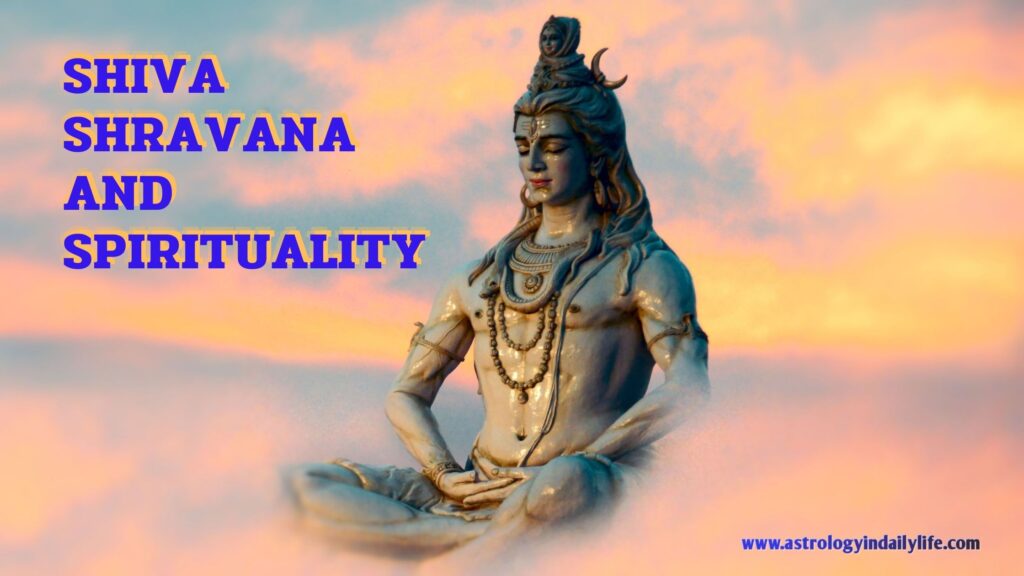
Discover the essence of Shravana Maas, an auspicious month in Hinduism. Explore its deep significance, effective remedies, and empowering mantras in this blog – your one-stop guide to unravel the secrets of this sacred time.
GURU PURNIMA: THANKSGIVING TO THE DIVINE MASTERS

Explore the transformative power of Guru Purnima, diving into its profound meaning, celebrating its significance, and discovering potent remedies for spiritual growth.