
ASTRO-YOGA: COSMIC GUIDANCE FOR MIND, BODY & SPIRIT

Yoga and astrology are both ancient practices that have been intertwined in various cultures and traditions. Certain yoga poses align well with the characteristics associated with astrological signs based on their elemental qualities (fire, earth, air, water) or characteristics associated with their signs. Yoga and astrology work in unison to align energies with cosmic forces and astrological patterns. Here are some yoga poses that are beneficial for different zodiac signs: Aries: Warrior I (Virabhadrasana I): Aries are known for their strong and determined nature. Warrior I builds strength and confidence, allowing Aries to channel their energy into focused action, build strength, and cultivate a sense of focus and determination, which aligns well with the sign’s characteristics. Mountain Pose (Tadasana): This pose helps Aries ground themselves and cultivate stability amidst their dynamic energy. This yoga pose is particularly beneficial for grounding and centring themselves. Tadasana helps cultivate awareness of breath, posture, and alignment, fostering a sense of harmony and balance. Taurus: Tree Pose (Vrikshasana): Taurus individuals appreciate stability and connection with nature. Vrikshasana is a fundamental standing yoga posture that helps improve balance, concentration, and strength. Tree Pose helps them to stay grounded and find balance and stability. Corpse Pose (Savasana): Savasana involves lying flat on the back, arms relaxed at the sides with palms facing up, and legs extended comfortably with feet falling outward. Taurus can fully relax and restore their energy in Savasana, allowing them to let go of tension and find deep inner peace. Gemini: Half Lord of the Fishes Pose (Ardha Matsyendrasana): Gemini individuals benefit from spinal twists to stimulate their curious minds, improve digestion, stimulate the abdominal organs and promote flexibility of the spine and hips. Additionally, it helps to relieve stiffness in the back and neck. Alternate Nostril Breathing (Nadi Shodhana): This breathing technique helps balance Gemini’s dual nature and calm their restless minds, enhancing focus, and potentially aiding in their ability to adapt to changing situations. Nadi Shodhana is particularly helpful for managing their dynamic and sometimes scattered energy, promoting focus, and enhancing mental agility. Cancer: Child’s Pose (Balasana): Cancer individuals seek comfort and emotional security. Child’s Pose allows them to surrender and release tension, nurturing their emotional well-being. It has calming, grounding and relaxing effects – much needed by the Cancerians. The practice of this asana improves mindfulness and body awareness. Moon Salutation (Chandra Namaskar): The Moon rules Cancer, so practising Moon Salutations helps them connect with their intuitive side and honour lunar energy. Each posture in the sequence corresponds to a phase of the Moon and is performed with mindful breathing. Leo: Lion’s Breath (Simhasana): Leo individuals express themselves with confidence and vitality. Lion’s Breath helps release pent-up energy and fosters self-expression. It is the roar that releases tension in the body as it stimulates and energizes the throat. The roar is not only a physical action but also a symbolic release of emotional tension. Sun Salutation (Surya Namaskar): The Sun rules Leo, and Sun Salutations help them embrace their fiery energy and awaken their inner strength. It strengthens the Sun in the birth chart, influencing self-respect, reputation, health and leadership qualities. Surya Namaskar helps in balancing the flow of prana (life force energy) throughout the body’s energy channels (Nadis). Virgo: Seated Forward Bend (Paschimottanasana): Virgo individuals value introspection and inner alignment. Seated Forward Bend promotes focus and balance while relieving tension and stiffness in the back, shoulders and neck. As one bends forward, the pose has a soothing effect on the mind, reducing stress and providing a sense of deep relaxation. Bridge Pose (Setu Bandhasana): Setu Bandhasana, also known as Bridge Pose, is an inverted back-bending asana in yoga. This pose helps Virgo individuals ground themselves and find stability while opening their heart and throat chakras. It helps enhance spinal flexibility and decompress the spine. Libra: Dancer’s Pose (Natarajasana): Libra individuals seek balance and harmony in all aspects of life. Dancer’s Pose cultivates grace and balance while opening the heart and expanding energy. It helps cultivate mindfulness and boost self-confidence. This Pose helps develop mindfulness and presence, fostering a deeper connection between mind and body. Partner Yoga Poses: Libra thrives on harmonious relationships, so practising Partner Yoga Poses fosters connection and mutual support. Partner yoga can help improve focus and concentration and help build stronger connections, friendships and social skills. You can perform poses like the Double Boat Pose, Double Tree Pose, Double Dancer Pose, Partner Wheel Pose, etc. Scorpio: Cobra Pose (Bhujangasana): Scorpions embrace transformation and renewal. Cobra Pose activates the spine and taps into its transformative energy. It stimulates blood circulation throughout the body, promoting cardiovascular health and boosting energy levels. Bhujangasana helps open up the heart centre and encourages the flow of energy throughout the body, which can help Scorpios manage their emotions and maintain balance. Warrior II (Virabhadrasana II): This pose strengthens the legs and opens the hips, helping to release tension and promote focus, which can be beneficial for Scorpio’s intense nature. It is a fantastic pose for summoning up emotional courage and mental resolve to face life’s battles. The pose encourages deep breathing and mindful awareness, which can help Scorpios navigate their emotions with greater ease. Sagittarius: Warrior Poses (Virabhadrasana I, II, III): These poses help build strength, focus, and confidence, which are qualities that align well with the adventurous and fearless nature of Sagittarius. Reflecting Sagittarius’s bold spirit, the Warrior Pose, embodies strength and courage akin to that of a warrior. Archer Pose (Akarna Dhanurasana): This
VASANT PANCHAMI – AMAZING MYTHS, RITUALS AND MANTRAS
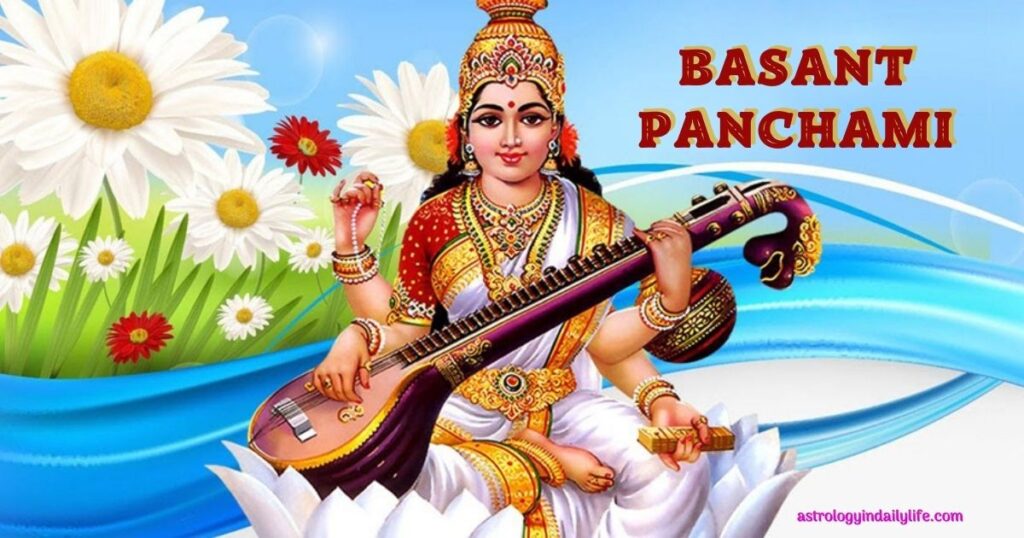
This year, Basant Panchami will be celebrated on Wednesday, 14th February. Basant Panchami Pooja Muhurat: 07:08 AM to 12:53 PM (Total Duration = 5 Hours 45 Mins) Basant Panchami marks the end of winter and welcomes spring. There is a saying in Punjab “आई बसंत पाला उडंत” (Ayi Vasant aur pala udant) meaning that with the arrival of spring (Vasant) season, cold (Pala) flies off. Let us discover how people celebrate Basant Panchami and what is its significance. BASANT PANCHAMI CELEBRATIONS IN DIFFERENT STATES: The uniqueness of Indian festivals is that most of them indicate the beginning of a season or a month of the Hindu calendar. Vasant Panchami is one such festival that occurs on the fifth day of the bright half of the Magha (sometime in early February) month. Thus, it marks the advent of the Spring season. ‘Vasant’ or ‘Basant’ means ‘Spring’; while ‘Panchami’ means ‘occurring on the fifth tithi (date)’. Spring is a season of hope, rebirth, regeneration, regrowth, and rejuvenation. Consequently, people celebrate the arrival of this season with much joy, delight and enthusiasm all over India. Muslims too celebrate Basant Panchami as ‘Sufi Basant’ in Sufi shrines. Besides, in Punjab and other North Indian regions, they celebrate it as the ‘Basant Festival of Kites’. At Amritsar’s Harmandir Sahib (Golden Temple), the Sikhs initiate singing of the Basant Raga on this day which continues till the first day of the Vaisakha month (sometime in April/May). In the state of Bihar, farmers celebrate it as the ‘Harvest Festival’, and as ‘Siri Panchami’ in West Bengal. Even in Uttarkashi, it is a ‘farmer’s festival’ where the farmers offer prayers to Mother Earth and the crops besides following other rituals related to agriculture and harvesting. The shrine of the Sun God in Aurangabad district, Bihar known as the Deo-Sun Shrine, was established on Basant Panchami. Hence devotees adorn the statues with new red clothes on this day. Furthermore, on this day, the priests of the Shri Banke Bihari temple of Vrindavan signal the start of Holi celebrations by tossing Abeer and Gulal on devotees. Also, the famous Shah Bihari temple in Vrindavan opens the ‘Basanti Kamra‘ (The Yellow Room) for devotees. The entire room is yellow in colour. The ceiling and the walls have multicoloured paintings of Radha and Krishna. ORIGIN AND SIGNIFICANCE OF BASANT PANCHAMI: Since early times, Vasant ritu – the Spring Season – has been considered as ‘Rituraaj’ – the king of all seasons. And this is not without its reasons. Vasant is the time when Nature presents herself in her most beautiful and flourishing form. It is the season when fragrant flowers like bela, chameli, juhi, (varieties of Jasmine) etc. bloom in abundance; flowers like raat-rani (‘night jasmine) blossom at night. The air is fragrant with invigorating scents; particularly the faint aroma of the Mango blossoms conquers the senses. The most attractive sight is that of the yellow and green mustard fields in full bloom. Not surprisingly, YELLOW is the predominant colour of this season. ‘Basanti’ is another name for the colour yellow. It symbolizes enlightenment, prosperity, dynamism and optimism. People wear bright yellow clothes – the colour of the mustard flower that indicates the onset of spring and marks the day with music, dancing, and kite-flying. Devotees offer yellow flowers to Goddess Saraswati and apply a yellow (turmeric saffron) tilak on their foreheads. They even prepare yellow-coloured delicacies like kesar halwa, kesari bhaat (yellow rice), boondi laddoo and maalpuas. This festival celebrates the liveliness and vibrancy of nature after autumn; it symbolizes the end of the days of darkness viz ignorance and awakening into the spirit of Spiritual enlightenment. LEGENDS REGARDING BASANT PANCHAMI: In the early times, Vasant Panchami was more a festival of joy, of celebration of love and a symbol of enjoyment and gaiety. Kamadeva, the God of Love and his consort, Rati are still worshipped in many regions of India on this day. In fact, Vasant Panchami initiates the spring festive cycle which culminates with the celebration of Holi. This 40-day period between Vasant Panchami and Holi corresponds with the 40 days of Rati’s (Kamadeva’s wife) remorse after her husband, Kamadeva was reduced to ashes by Lord Shiva for disturbing his meditation with his love arrows. Basant Panchami is celebrated very enthusiastically by the Krishna Bhaktas (devotees) and followers too. They consider it like the reverence of ‘Divine Desire’ which flows from their heart for their beloved, Krishna. It marks the beginning of the season of Love and fulfilment of desires. It is also believed that Lord Brahma, the Creator of the Universe, created Goddess Saraswati on this very day to rid the Earth of its dullness and quietness. Hence, Vasant Panchami is celebrated by many as Goddess Sarasvati’s birthday or day of appearance. SARASWATI PUJA: SARAS means EASY and WATI mean FLOWING. So Goddess Saraswati is a symbol of knowledge that flows easily to anyone who is willing, capable and ready to receive it. One of the many names of Goddess Saraswati is ‘Vakdevi” – the Goddess of Speech. Another name is Veena Vadini (One who plays the Veena – Harp) and Vaani Daayani – Giver of Speech. She is the personification of all kinds of Knowledge, Speech, Eloquence, Wisdom and all Art forms. Hence students and artists worship Her on this day. Educational institutes organise special worship of Goddess Saraswati. Students and devotees place stationery and musical instruments, etc. before Her and worship them along with the Goddess to invoke Her blessings. Vasant Panchami is a three-day festival where people worship Goddess Saraswati and pray for blessings of knowledge and to get rid of laziness and ignorance. The ritual of initiating learning to children – Vidya Arambham or Abhyasa Arambham – is one of the important rituals of Vasant Panchami – as it is an auspicious day to begin a child’s education. The ritual consists of writing the Beej Mantra of Goddess Saraswati “Aiyang” (ऐं) on the tongue of the kids as the first syllable of education with Saffron. Grown-ups
ALL YOU WANTED TO KNOW ABOUT NAVRATRI
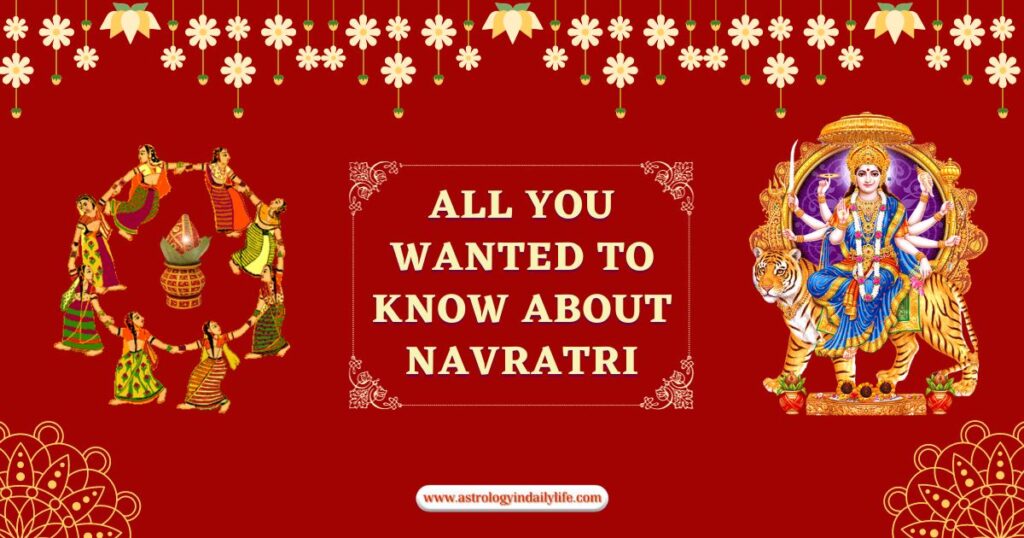
Navratri means the nine nights of vibrant worship, music that echoes in the soul, and a spectacle of colours that illuminates the darkest nights. Navratri, which translates to “nine nights” in Sanskrit, is not merely a festival; it’s a grand carnival of spirituality and cultural splendour. Join me on a fascinating journey through the enchanting realms of Navratri to learn about the significance, rituals, dos and don’ts, celebrations, and more. Sharadiya Navratri: 2025 Shardiya Navratri starts on Monday, September 22, 2025, and will continue till the Dussehra celebration on Thursday, October 02, 2025. Besides, Goddess Durga arrives on an elephant this year. The Visarjan (immersion) of the idol of Maa Durga will be on Vijayadashami, i.e. on 02 October 2025. Nine Nights – Three Dimensions The nine days of Navratri are a symbolic journey. In the first three days, the focus is on overcoming laziness and inertia (Tamas). The next three days are about controlling and overcoming our desires and passions (Rajas). Finally, the last three days are dedicated to maintaining our minds in a state of purity and wisdom (Sattva). Thus, the nine days are an opportunity to recharge our energies. For the first three days, we worship Maa Durga, seeking her strength. Then, we turn our attention to Maa Lakshmi, symbolizing wealth and prosperity, for the next three days. Finally, we invoke Maa Saraswati, representing knowledge and wisdom, during the last three days of Navratri. The tenth day of the festival marks Vijayadashami, also popularly known as Dussehra. The three goddesses are the incarnations of Shakti, the mother goddess. Each goddess signifies different aspects of life, guiding us toward a balanced and harmonious existence. Colours of Navratri Each day of Navratri is associated with a specific colour, and devotees wear clothes of that colour to celebrate the festival. The colours may vary based on different traditions and regions, but generally, the colours for the nine days of Navratri are: Day 1 (Pratipada): Grey Day 2 (Dwitiya): Orange Day 3 (Tritiya): White Day 4 (Chaturthi): Red Day 5 (Panchami): Royal Blue Day 6 (Sashti): Yellow Day 7 (Saptami): Green Day 8 (Ashtami): Peacock Green Day 9 (Navami): Purple Ghatasthapana Kanya Pujan Kanya Puja, also known as Kanjak Puja, is a ritual on the eighth (Ashtami) and ninth (Navami) days of Navratri. It is a way of honouring the divine feminine energy and acknowledging the power of Maa Durga. The rituals include washing their feet, tying a red sacred thread (mauli) to their wrists and a tilak to their foreheads. Then touch their feet and seek the Goddess’s blessings through them. During the ritual, devotees welcome nine girls into their homes and offer presents and tasty bhog prasad to them. Special bhog dishes (kanjak) include poori, chana, sheera/halwa, sweets and kheer, while gifts include new dresses, bangles and money. Fasting/Vrat Fasting during Navratri is considered a way to purify the body and soul, enhance spirituality, and build self-discipline. Types of Fasting: There are different ways people observe fasts during Navratri. Some people abstain from all kinds of food and consume only water or fruits for the entire duration. While others opt for a diet that excludes certain foods like grains, non-vegetarian items, onion, and garlic. Use rock salt instead of common salt for cooking. Foods Allowed: One can have fruits, milk, yoghurt, and specific flours like buckwheat flour (kuttu ka atta) or water chestnut flour (singhara atta), nuts, seeds, dry fruits and coconut. Moreover, you can prepare simple dishes like Sabudana Vada, Sabudana Khichdi, Singhare ka Halwa, Kuttu Ki Poori, Singhare Ke Pakore, as well as sweet potato, arbi (colocasia), and yam (suran). Foods to Avoid: Grains like wheat, rice, and oats, and lentils like dals and pulses, Non-vegetarian foods, onion, garlic, ginger, and certain spices like turmeric, cumin, and mustard. Breaking the Fast: The fast is normally broken in the evening with a special meal called “prasad” that is offered to the Goddess first and then consumed. What to do during Navratri? Navratri Celebrations North India: In North India, Navratri celebrates the triumph of lord Rama over Ravana and Rama’s homecoming to Ayodhya after fourteen years of exile, along with his wife Sita and brother Lakshmana. People in UP and Bihar celebrate Navaratri with the Ramleela– a dramatic enactment of the life of Lord Ram from the Hindu epic Ramayana. East India: In West Bengal and the North-East, Navratri is known as Durga Puja. People celebrate goddess Durga’s triumph over Mahishasura. Durga Puja marks the homecoming of goddess Durga from Kailash Parvat to her maternal house. Devotees offer prayers in the evening and perform a dhunuchi naach, a special dance with earthen lamps. Dancing to upbeat dhak (a large drum) beats, hopping from one pandal to the next, munching on lip-smacking bhog prasad and adorning yourself with beautiful, traditional attire is a must-do during Durga puja in West Bengal. West India: In West India, especially in Gujarat, people celebrate Navratri with a lot of enthusiasm and verve. The women who are fasting dedicate their prayers to an earthen pot called garbo lit with diyas (lamps). These colourful pots represent the source of life and the light represents shakti (power). People dress in colourful traditional attire and participate in energetic traditional Garba and Dandiya Raas dances. South India: The South Indian way of celebrating Navratri is more spiritual and artistic. In Tamil Nadu, one of the significant aspects of Navratri is the Golu display. Golu is an exhibition of various dolls and figurines depicting gods, goddesses, and other themes. Devotees also perform Ayudha Puja wherein they worship Agricultural implements, tools, books, musical instruments, machinery and automobiles. In Telangana, women arrange colourful flowers in the form of a cone and offer prayers to Goddess Bathukamma, seeking her blessings for health and prosperity. In Karnataka. Yakshagana, a night-long dance in the form of epic dramas from the Puranas, are enacted during the nine nights of Navratri. The people of Kerala give prominence to Goddess Saraswati, the Goddess of
AMAZING SCIENTIFIC REASONS BEHIND TRADITIONAL RITUALS

AMAZING SCIENTIFIC REASONS BEHIND TRADITIONAL RITUALS Many traditional customs, rituals and rites which we have been following for years may seem to be irrational or superstitious to some. But on introspection, one realises that these traditional rituals indeed have scientific or logical reasoning behind them. Let us understand the scientific reasoning of a few Indian traditional rituals and habits. NAMASTE-GREETINGS WITH FOLDED HAND NAMASTE = NA + MA + ASTE = ‘I’ + DON’T + EXIST. Yes, this humbleness is a part of the ancient Indian Culture. When we greet someone, it should mean to honour, to respect that person. Namaste is a representation of just THAT. It’s like saying: ‘ I do not harbour any ego while associating with you‘. What a way to begin good relations! APPLYING TURMERIC TO THE BRIDE/GROOM: In most Hindu traditions, Haldi (turmeric) paste application to both the bride and the groom as a pre-nuptial ritual. Why? – Just because it is an auspicious ritual? But what makes it so auspicious? Well, marriage is a social function in India – a great time for a get-together. The Bride/Groom is surrounded by relatives, friends and well-wishers from DIFFERENT places and environments. Now the bride/groom may be sensitive to certain things. Thus, the chances of the spread of allergies or viral are high. So as a precaution, applying Haldi all over the body became a custom. Who doesn’t know that turmeric is a wonderful antiseptic? Besides protecting the skin from rashes and pimples, it also exfoliates the skin making it smooth and luminous. For the same reasons, in many communities, it is a necessary custom to tie a piece of haldi to the wrist of the bride/groom. CHARAN SPARSH: Since ancient times, children and students have been following the ritual of touching the feet of their parents and teachers. The gesture of touching the feet of elders is another form of an important yoga asana – Padahastasana. Charan Sparsh – Touching the feet of elders is a good stretching exercise that improves blood circulation and helps in strengthening the back – thereby improving the posture. But then why touching the feet of ‘elders’? Because bending down is also a symbol of humility – this posture teaches us a lesson that howsoever successful or big we may become, our elders are always superior to us and deserve all our humble respect and salutations. PARIKRAMA: Parikrama or Pradakshina means walking the circular path around a religious spot/place/temple – barefoot. Many of us have read about the Magnetic effect of electric current (Oersted’s Experiment). In fact, all energy sources have magnetic fields around them. Religious temples are generally places that are great sources of energy. Performing Parikrama of such places energies oneself. Besides this, walking bare feet works as an acupressure exercise for tired feet. Have you noticed that you have to walk long distances or climb many steps to reach most of the temples / spiritual spots? BLOWING A CONCH (SHANKH): Blowing the conch is a part of daily rituals for performing the pooja and ceremonies in temples and houses. Did you know that blowing a Shankh is beneficial both to the person who blows the shankh and to those around him? – it energizes both. First of all, blowing a shankh involves taking a deep breath and controlling it – as the Shankh Naad is done in one breath with lungs filled to full capacity. Secondly, when a shankh is blown, the sound energy emitted by it is of such high intensity and frequency that it destroys harmful germs in the immediate atmosphere, cleanses them and reverberates strong positive energy around. DAHI SHAKKAR (CURDS WITH SUGAR): Dahi Shakkar is one of the age-old rituals of India. It is an ancient custom still prevalent in India to have curds with sugar before setting out for some important work such as exams/interviews/business meetings. The logic behind this is: Curd is a coolant and a good digestive agent. It prevents heartburn and gas formation. Sugar is an instant energizer. One needs to be cool, collected and energized when setting out to accomplish an important task. WEARING TILAK ON THE FOREHEAD: A Tilak is a mark worn on the forehead by Hindus. It is applied between the eyebrows – the seat of Ajna Chakra. Ajna Chakra is the seat of intuition, memory and thinking. When a person is tensed or worried, electromagnetic waves in the form of heat energy are emitted through this Ajna Chakra. This intense energy emission causes headaches. The ‘Tilak‘ not only cools the head but also minimizes energy loss. Research has proved that the application of Tilak clears sinuses. The application of Tilak on the forehead stimulates the discharge of serotonin and beta-endorphins in the brain. This reduces the negativity of the mind and increases confidence. HAVING FOOD SITTING ON THE FLOOR: Indians have a tradition of having meals sitting on the floor cross-legged. In fact, this is a yogic position – ‘Sukhasana‘. In this position, one has to slightly move his body forward to eat and then come back to the original position. This repeated action results in activating the abdominal muscles; which increases the secretion of stomach acids and allows food to digest faster. The cross-legged position not only enhances blood circulation in our body but also calms the nerves. PIERCING OF EARS AND NOSE: Ear piercing or Karna Vedha is one of the 16 samskaras or sacraments mentioned in the Ayurveda. Piercing the ear helps maintain a healthy menstrual cycle in females. Besides, it improves the health of the intestines and testicles in males. The ear lobes consist of acupressure points that get stimulated on the piercing. This ensures healthy brain development and improvement of memory. Also, piercing the left nostril helps to minimize the discomfort and pain experienced by females during menstrual cycles and childbirth. WORSHIPING TULSI PLANT: Every Hindu householder considers Tulsi to be a very sacred
PRESENTING AN ABSOLUTELY NEW APPROACH TO ASTROLOGY

“Is Astrology Real?”, “Does Astrology Really Work?” – I am sure these questions have crossed the minds of millions of people across the globe. I believe that Astrology is not about the FUTURE, it’s more about the PAST; it is about our past Karma and its impact on our present lives. An in-depth analysis of the birth chart helps us to understand why we are the way we are and thus it can help us to grow materialistically, philosophically and spiritually. Astrology can be used in every walk of life to take major decisions and make wise choices. In fact, it can prove to be a useful tool to improve our daily lives. Simple remedies and changes in habits can definitely bring many long term positive changes in life, READ MORE: Click on the link below to read in detail an entirely different approach to this mystical science of planets and stars: https://www.mysticmag.com/psychic-reading/interview-bella-arora/