

The Ultimate Guide to Plan your Day – with Astrology
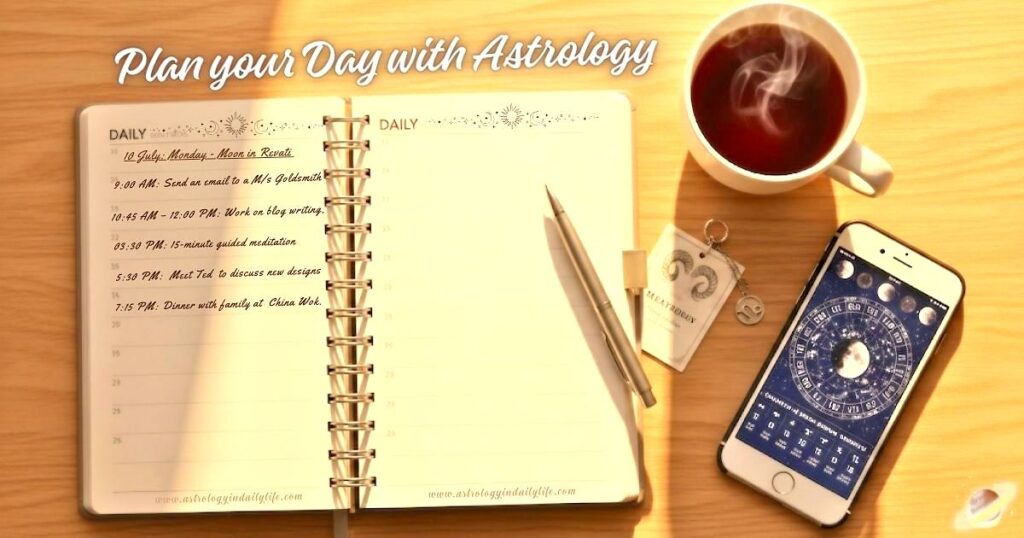
Ever felt like the whole day slips through your fingers despite you trying your best to stay organised? You are not alone. Life is chaotic and unpredictable, too! Unexpected things turn up at the last moment, plans change, distractions muddle up your schedule, and so on. But here’s something most people overlook: you can actually plan your day with astrology. Vedic astrology, in particular, offers practical and time-tested insights to bring structure, focus, and emotional balance into your daily routine. In this post, I will explore how simple astrological guidelines—like tracking the Moon’s movement—can help you plan and manage your day with more clarity and confidence. How Can I Start My Day with Purpose? Your emotional tone for the day is set by the Moon, which governs the mind and emotions. So, every morning: What Are the Best Strategies to Stay Organised? Your Ascendant (Lagna) has a significant impact on how you approach structure and time. If you do not know your ascendant, use your Sun sign as a guiding force. Plan your activities according to your sign: Fire signs (Aries, Leo, Sagittarius): Incorporate action-oriented tasks and creative outlets; brief, intense efforts are more effective than lengthy tasks. Water signs (Cancer, Scorpio, Pisces): Keep your planning straightforward and filled with positive emotions and intuitions. Earth signs (Taurus, Virgo, Capricorn): Break down large goals into smaller, practicable steps. Set aside time schedules in blocks and make tangible progress daily. Air signs (Gemini, Libra, Aquarius): Embrace flexibility when planning, focus on adaptability and engage in activities that stimulate the mind. How Do I Overcome Procrastination? Procrastination often links to your Saturn. A weak or afflicted Saturn shows where you feel stress and resistance and where procrastination tends to creep in. If you are constantly delaying things, check what house Saturn occupies in your chart. If Saturn is in the 6th or 10th house, you tend to be perfectionistic about work, which can make you feel pressured. Take the stress off and do the easiest part first. If Saturn is in the 1st or 12th house, then you may feel short on energy or be self-destructive. It is advisable to create a schedule which is gentler, not rigid. The BEST REMEDY is: Commit to doing something at the same time every day, even if only for 10 minutes. Respect your energy rhythms. Saturn rewards consistency, not speed. 6th house and Daily Planning: Your 6th house rules your daily routines and health. It specifies what sustains you energetically. Identify 1–2 essential commitments based on the planets/sign of the 6th house and plan accordingly: How Can I Set Achievable Goals? Your Sun sign and current dasha or transit will help you here. Your Sun represents your core aspirations and the aspects in which you can excel. But transits tell you when to push and when to pause. Vedic Astrology’s Daily Planner: Day Ideal For Monday Emotional work, introspection, intuitive planning, compassionate roles, reflection, nurturing loved ones, self-care Tuesday Taking action, problem-solving, execution of plans, assertive decisions, fitness, and taking bold steps Wednesday Discipline, responsibility, consistency, attention to detail, completing pending tasks, and long-term planning Thursday Growth, wisdom, long-term planning, teaching, healing, financial and spiritual matters Friday Love, beauty, luxury, money matters, creativity, self-care, harmony in relationships Saturday Discipline, responsibility, consistency, attention to detail, completing pending tasks, and long-term planning Sunday Leadership, visibility, confidence-building, setting targets, personal goals, health and relaxation. Conclusion: By understanding your chart and the daily movements of the Moon or planets through Vedic astrology, you gain insight into your inner self. Make sure to review the Moon’s sign and your top 3 priorities tomorrow morning and align at least one of them with what your chart supports emotionally and energetically. Let astrology be your daily compass Align Your Body with the Stars! Check out the best yoga pose for your zodiac sign 👉 Read: https://astrologyindailylife.com/astro-yoga-for-each-sign/
RAHU TRANSIT 2025: EFFECTS & EASY REMEDIES FOR YOU

RAHU-KETU TRANSIT 2022
Curious how the 2025 Rahu-Ketu transit will shake up your life?
This guide is all about you—your career, relationships, health, and mindset. Whether you’re facing confusion or chasing a big dream, find out what this karmic shift means for your zodiac sign and what you can do about it. Remedies included, because your peace of mind matters.
AKSHAYA TRITIYA: NEW BEGINNINGS, PROSPERITY AMPLIFIED

hink you know Akshaya Tritiya? Think again. Uncover the deeper meaning behind this powerful day of cosmic alignment and timeless abundance.
ALL YOU WANTED TO KNOW ABOUT DHANTERAS

DHANTERAS – THE BEGINNING OF DIWALI Deepawali (Deepa-Lamps; Awali-Row) meaning ‘A row of lamps’ is also called Diwali in its shortened version. Diwali is a five-day festival celebrated all over India and also in many other countries across the globe. Each of the five days of Diwali has its own meaning and significance. Dhanteras marks the beginning of the festivities of Diwali. Meaning of Dhan-trayodashi: Trayodashi means “thirteenth day” of the Hindu fortnight and Dhan means “wealth”. Thus, as the name implies, Dhanteras falls on the thirteenth day of Krishna Paksha (Dark Fortnight) in the Hindu month of Kartik. Hence another name for Dhanteras is Dhantrayodashi. People worship Goddess Laxmi and Lord Kuber to bless them with prosperity and well being. What is the Significance of Dhanteras? In the story of Sagar Manthan, it was on this day that Lord Dhanvantari appeared with the nectar urn from the churning ocean. Along with him, jewellery and precious gems also emerged from the ocean. Since then this day was named ‘Dhanteras’ and the tradition of buying utensils and jewellery started. Ayurvedic vaidyas (doctors) consider Lord Dhanwantri as the Father of Ayurveda-the bestower of health and celebrate this day as his birthday. They distribute neem leaves and mishri (candy sugar) as prasad to visitors. Dhan also means Wealth. Undoubtedly, Dhanteras is also very important for businessmen, traders and merchants. Goddess Lakshmi along with Lord Kubera (God of wealth) is worshipped on this day. Dhanteras is also known as the day of “Yama Deep Daan”. Lord Yama (God of Death) is worshipped on this day to provide prosperity and well-being to all and to avert untimely death. Lord Kuber is generally worshipped through the medium of Kuber Yantra. What is done on Dhanteras? The following are the different rituals and traditions followed during Dhanteras: SHOPPING: Dhanteras marks the grand finale of all major Diwali shopping. It is auspicious to purchase a new cooking/eating vessel this day. The new utensil purchased is filled with puffed rice (kheel) and some coins. This vessel is then kept at the place where Lakshmi Pooja is to be done on Diwali night. It is believed that on Diwali night, Lord Dhanwantri will fill this vessel with health, while Lord Kubera will fill it with wealth. 2. OFFERINGS: Different types of offerings are prepared on this day in different regions of India. In Maharashtra, there is a tradition to offer a Naivedya (holy offering) of lightly crushed dry coriander seeds and jaggery. Whole wheat porridge or atte ka halwa or lapsi is prepared and distributed as prasad in parts of North and East India. In most of the households, Panchamrit, a preparation made with honey, curd, milk, ghee and sugar is distributed as prasad. Also, Kheer made from rice, milk and sugar is another favourite offering. 3. YAM DEEP DAAN: In the evening, one a four-faced Diya or thirteen oil lamps made of wheat flour are lit. Devotees keep these lamps outside the house with their flame facing southwards. (This is the only day in the whole year when the lamp’s flame is kept facing southwards.) The following mantra is to be recited while lighting the lamp/s: मृत्युना पाशदंडाभ्यां कालेन श्यामसह । त्रयोदश्यांदिपदानात् सूर्यजः प्रीयतां मम ।। Meaning: I offer these thirteen lamps to Yama, the son of the Lord Sun so that He liberates me from the clutches of death and bestows His blessings. What can you buy for Dhanteras? What shouldn’t you buy for Dhanteras? Silver/gold jewellery or coins. Utensils, preferably copper or brass vessels. Brooms. Gomati Chakra, Cowries, Gunja Seeds, Conch/Shankh, Lotus seed mala/Gatte ki Mala. Coriander seeds; preferable plant some of these on Dhanteras. New books of accounts. Idols/Yantra of Laxmi, Ganesha & Kuber. Property. Salt. Avoid buying steel, iron, aluminium, plastic, glass or ceramic utensils on Dhanteras. Rahu has an influence on these elements. Avoid buying a vehicle/car on Dhanteras. Sharp instruments like knives, scissors, etc. Black or dark coloured articles. Mirrors. Oil, Ghee, Butter. Crockery. Gifts for others. Wood or wooden articles. Why do we buy broom on Dhanteras? Buying a new broom on Dhanteras is a very important traditional ritual. We welcome Goddess Lakshmi to our clean houses to destroy all the negative energies and get rid of financial problems. This brings prosperity and fortune to the family. It also helps to get rid of debts. Whenever you buy a new broom, tie a white thread to it. This will ensure that Maa Lakshmi resides in your house permanently. Purchasing three brooms is considered auspicious. DHANTERAS 2024 MUHURAT Dhanteras Explained: Your Quick Q&A Guide Q1: What exactly is Dhanteras? Dhanteras, also known as Dhantrayodashi, is the first day of the five-day Diwali festival. Celebrated on the 13th day of the dark fortnight in the Hindu month of Kartika, it marks the beginning of Diwali festivities. Q2: Why is it called ‘Dhanteras’? ‘Dhan’ means wealth, and ‘Teras’ refers to the 13th day. The day is associated with the emergence of Lord Dhanvantari, the god of health and Ayurveda, and the goddess Lakshmi, symbolising wealth and prosperity. Q3: What are the key rituals of Dhanteras? Cleaning and Decorating Homes: Homes are thoroughly cleaned and decorated with rangoli and lights to welcome prosperity. Lighting Diyas: Lighting oil lamps, especially 13 diyas facing south, is a tradition to honor Yama, the god of death, seeking protection and longevity. Lakshmi and Dhanvantari Puja: Devotees worship Goddess Lakshmi for wealth and Lord Dhanvantari for health. Shopping: Purchasing gold, silver, or new utensils is considered auspicious, symbolizing the invitation of wealth into the home. Q4: What should I avoid buying on Dhanteras? It’s advisable to avoid purchasing items like brooms, salt, or steel utensils, as they are considered inauspicious on this day. Q5: Can I perform Dhanteras rituals at home? Absolutely! Performing Dhanteras rituals at home is a wonderful way to invite prosperity and health into your life. Ensure to follow the auspicious timings and use traditional offerings for the puja.
ALL YOU NEED TO KNOW ABOUT SHRAVANA MAAS
Discover the essence of Shravana Maas, an auspicious month in Hinduism. Explore its deep significance, effective remedies, and empowering mantras in this blog – your one-stop guide to unravel the secrets of this sacred time.