

UNDERSTANDING THE SIGNIFICANCE OF NAVRATRI

The uniqueness of Hindu festivals is that they are all related to some or the other significant astronomical events or changes. Navratri is not an exception to this rule. The nine nights of Navratri help us tune with our creative energies and rejuvenate ourselves, both physically and mentally. NAVRATRI MARKS THE CHANGE OF SEASONS: The change of seasons in a year is directly connected to both the Equinoxes and the Solstices. Equinoxes and Solstices are astronomical events that mark the sun’s apparent movements in the sky. The Summer Solstice marks the time when the Sun reaches the highest point in the Northern sky. Winter Solstice marks the movement of the sun to the lowest point in the Southern sky. Equinoxes are the periods when the plane of the Earth’s equator is in line with the centre of the Sun’s disk. There are two Equinoxes in a year, in March and September. Days and nights are generally of equal duration then. The two Solstices occur in June and December. Correspondingly, there are four Navratris celebrated in India: Chaitra or Vasanta Navratri (March-April) marks the beginning of the summer season. Ashadha Navratri (June-July) marks the beginning of the monsoon season. Sharada Navratri (September-October) marks the beginning of the winter season. Pausha/Magha Navratri (January-February) – marks the beginning of the autumn season. Of these, the Chaitra/Vasanta Navaratri and Sharada Navaratri are observed and celebrated by the householder and spiritual seekers alike. Ashadaha Navratri and Pausha/Magha Navratri are known as Gupt (Secret) Navratris – these are largely observed by people who perform Tantra Vidya or seek to obtain Siddhis (psychic powers) or the Shaktas (Devotees of Goddess Shakti). Of the four, the Sharada Navratri (also known as Maha Navratri) is celebrated with much gusto and fervour by all. These four periods are the focal points of change. They mark the end of what is old, spent, and harmful and the birth of something new. One can also see this as a period of retrospection, rejuvenation and rebirth on all three planes viz physical, mental & spiritual. This is the time to bring everything into balance. “Which Devi Maa should you worship this Navratri?” – Read here. PHYSICAL REJUVENATION: Equinoxes and the Solstices mark the transition period between two seasons. This is the time when bacteria thrive and viral infections/diseases are at their peak. At the same time, the body needs time to adjust to the changes in the climate and environment. Excessive and wrong eating habits, disturbed sleeping patterns and the onslaught of the climate result in low immunity and create an imbalance in the body by disturbing the three bio elements – Vata (Gas), Pitta (Bile) and Kapha (Phlegm). Detoxification: Navratri is the right time to detoxify and revitalize the body by balancing these three humours. Fasting is an essential part of the Navratri celebrations. Some people have only one meal a day. Most of them, however, abstain from certain high-energy foodstuffs and have only selected food items. Meat, grains, alcohol, onion, garlic, etc., are totally avoided; so are processed foods. The emphasis is on gluten-free grain alternatives, fresh fruits, yoghurt, etc., which are easy to digest. The Nine Goddesses – symbols of the Divine Energy – are invoked to help control and cleanse the nine openings of the physical body: 2 Chakshu (Eyes), 2 Karna (Ears), 2 Nasika (Nostrils), 1 Vadana (Mouth), 1 for Malotsarjan – Anus & 1 for Mutrotsarjan – Urinary opening. MENTAL REJUVENATION: Navratri is also the period of cleansing the mind of the nine evil forces – काम – lust क्रोध – anger लोभ – greed मोह – delusion अहंकार – ego ईर्ष्या – jealousy संशय – doubt राग – attachment द्वेष – hatred Fasting also has psychological benefits that include strengthening one’s willpower and removing emotional blocks. This is the time when one reflects inward. Self-control and discipline help to rid the mind of its impurities and nurture noble values. SPIRITUAL REJUVENATION: Mental control coupled with control over physical urges helps elevate one’s spiritual status. People involve themselves in spiritual practices such as meditation, pranayama, etc. The worship of all the forms of AdiShakti (Primal Energy) helps us destroy our basic, gross carnal tendencies and invoke the Divine Power within ourselves. This is the time for recharging one’s latent energies and activating one’s progress to the transcendental world. WHY THE EMPHASIS ON ‘NIGHTS’? Navratri is a festival of nine ‘nights’. There is a reason for this. Indian scriptures mention that “रात्रि रूपा यतोदेवी, दिवा रूपो महेश्वर”. Meaning that Shiv represents daytime, while Shakti is active during the nighttime. Shiv and Shakti are one; so also a day and night represent one complete day. The day is full of activity, while the silence of the night is the appropriate time to invoke and recharge energies. Hence, worshipers of the Feminine Primal force always choose the nighttime to worship the Devis – the Goddesses. Click here to read about the various NAVRATRI MANTRA REMEDIES.
AMAZING MANTRA REMEDIES FOR NAVRATRI
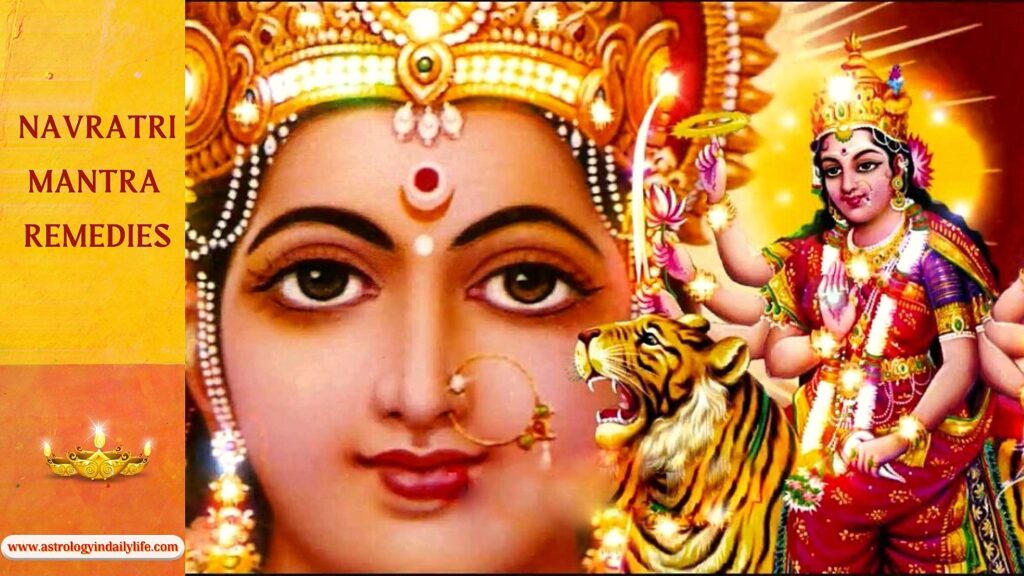
NAVRATRI, which is a very potent stretch of nine nights when one can perform remedies to rid oneself of problems and obstacles. Navratri Mantra remedies are very effective for various purposes such as: finding a suitable life partner begetting a child winning over adversaries recovering from health problems ensuring victory in lawsuits getting rid of debts resolving conflicts improving relationships Nevertheless, Navratri is also a very good time for performing astrological and mantra remedies, which can be used to pacify or reduce the malefic effects of planets in one’s horoscope. CLICK HERE TO READ: MOST EFFECTIVE NAVRATRI SHLOKAS AND MANTRAS One of the most effective remedies is DURGA SAPTASHATI PAATH, which means the recitation of the shlokas of Durga Saptashati. Durga Saptashati consists of 13 Chapters and 700 shlokas or mantras. In short, this collection is a powerful reservoir of mantras – every verse being a dynamic force. Mantra for enhancing luck and good health: Dehi Saubhagyamaarogyam Dehi Me Paramam Sukham Rupam Dehi Jayam Dehi, Yasho Dehi Dwisho Jahi || देहि सौभाग्यमारोग्यं देहि मे परमं सुखम्। रूपं देहि जयं देहि, यघो देहि द्विषो जहि।। Mantra to obtain special powers: || Om Aim Hreem Kleem Chaamundaaye Vichche || || ॐ ऐं ह्रीं क्लीं चामुण्डायै विच्चे ॐ || Mantra to remove obstacles in one’s life: || Dehi Saubhagyamaarogyam Dehi Me Paramam Sukham Rupam Dehi Jayam Dehi, Yasho Dehi Dwisho Jahi || || देहि सौभाग्यमारोग्यं देहि मे परमं सुखम्। रूपं देहि जयं देहि, यघो देहि द्विषो जहि।। Powerful mantra to get success in all kinds of work: || Sarvmangal mangalaaye shivay sarvaarth-saadhikay, sharanaye triyambakay gauri narayani namostutay || || सर्व मंगल मांगल्ये शिवे सर्वार्थ साधिके । शरन्ये त्रयम्बिके गौरी नारायणी नमोस्तुते ।। Mantra to solve problems: || Sharanagat Deenarta Paritranaparayane Sarvsyartihare Devi, Narayani Namostute || || शरणागतदीनार्तंपरित्राणपरायणे। सर्वस्यार्तिहरे देवि, नारायणि नमोघ्स्तु ते || Mantra for getting married or removing obstacles in marriage: || Hey Gauri Shankarardhangi Yatha Tvam Shankarpriyaa| Tatha Mam Kuru Kalyaani Kaantkatam Sudurlabhaam || || हे गौरि शंकरार्धांगि यथा त्वं शंकरप्रिया । तथा मां कुरु कल्याणि कान्तकातां सुदुर्लभाम || Mantra for getting a suitable wife: || Patni Manormam Dehi, Manovrittanusarinim Tarineem Durgsansarsaagarasya Kulodbhavaam || || पत्नी मनोरमां देहि मनोवृत्तानुसारिणीम्। तारिणीं दुर्गसंसारसागरस्य कुलोद्भवाम् || Mantra for conceiving a child: || Aum Garbarakshambigaayai cha vidhmaheMangala dhevadhaayai cha dheemaheeDhanno devi prachodayaat || || ॐ गर्भरकक्षांम्बिकाय़ै च विद्महे, मंगल देवतायै च धीमहि, तन्नौ देवी प्रचोतयात् || Navratri Mantra for solving debt problems and winning over enemies: || Om Hleem Bagalaamukhi Sarvadushtaanaam Vaacham Mukham Padam Stambhay Jihvaam Keelay Buddhim Vinaashaay Hring Om Swaha || || ॐ ह्लीं बगलामुखि सर्वदुष्टानां वाचं मुखं पदं स्तम्भय जिह्वां कीलय बुद्धिं विनाशय ह्रीं ॐ स्वाहा || To know which form of Maa Shakti to worship, click here. To read about the SIGNIFICANCE OF NAVRATRI, click here