
AKSHAYA TRITIYA: NEW BEGINNINGS, PROSPERITY AMPLIFIED

hink you know Akshaya Tritiya? Think again. Uncover the deeper meaning behind this powerful day of cosmic alignment and timeless abundance.
ALL YOU WANTED TO KNOW ABOUT NAVRATRI
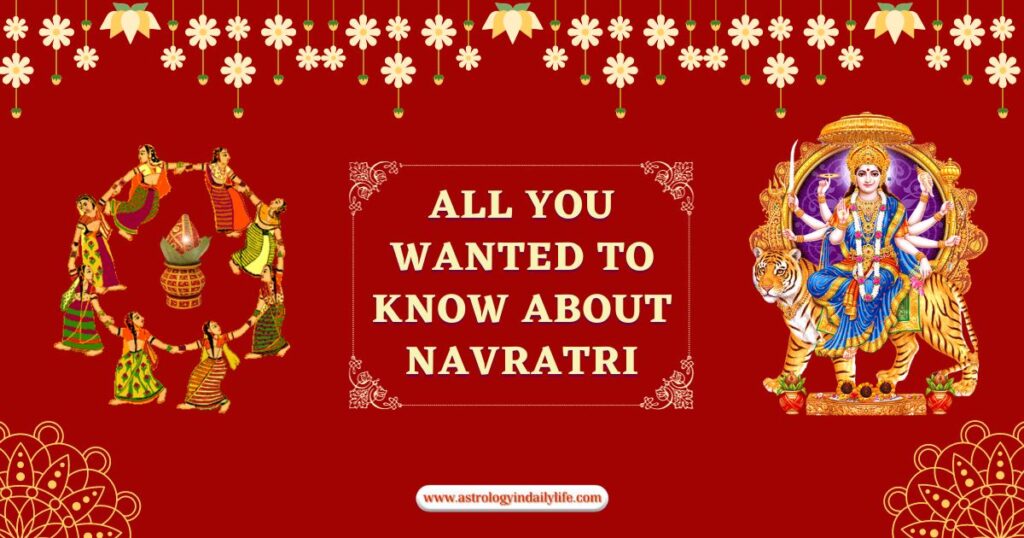
Navratri means the nine nights of vibrant worship, music that echoes in the soul, and a spectacle of colours that illuminates the darkest nights. Navratri, which translates to “nine nights” in Sanskrit, is not merely a festival; it’s a grand carnival of spirituality and cultural splendour. Join me on a fascinating journey through the enchanting realms of Navratri to learn about the significance, rituals, dos and don’ts, celebrations, and more. Sharadiya Navratri: 2025 Shardiya Navratri starts on Monday, September 22, 2025, and will continue till the Dussehra celebration on Thursday, October 02, 2025. Besides, Goddess Durga arrives on an elephant this year. The Visarjan (immersion) of the idol of Maa Durga will be on Vijayadashami, i.e. on 02 October 2025. Nine Nights – Three Dimensions The nine days of Navratri are a symbolic journey. In the first three days, the focus is on overcoming laziness and inertia (Tamas). The next three days are about controlling and overcoming our desires and passions (Rajas). Finally, the last three days are dedicated to maintaining our minds in a state of purity and wisdom (Sattva). Thus, the nine days are an opportunity to recharge our energies. For the first three days, we worship Maa Durga, seeking her strength. Then, we turn our attention to Maa Lakshmi, symbolizing wealth and prosperity, for the next three days. Finally, we invoke Maa Saraswati, representing knowledge and wisdom, during the last three days of Navratri. The tenth day of the festival marks Vijayadashami, also popularly known as Dussehra. The three goddesses are the incarnations of Shakti, the mother goddess. Each goddess signifies different aspects of life, guiding us toward a balanced and harmonious existence. Colours of Navratri Each day of Navratri is associated with a specific colour, and devotees wear clothes of that colour to celebrate the festival. The colours may vary based on different traditions and regions, but generally, the colours for the nine days of Navratri are: Day 1 (Pratipada): Grey Day 2 (Dwitiya): Orange Day 3 (Tritiya): White Day 4 (Chaturthi): Red Day 5 (Panchami): Royal Blue Day 6 (Sashti): Yellow Day 7 (Saptami): Green Day 8 (Ashtami): Peacock Green Day 9 (Navami): Purple Ghatasthapana Kanya Pujan Kanya Puja, also known as Kanjak Puja, is a ritual on the eighth (Ashtami) and ninth (Navami) days of Navratri. It is a way of honouring the divine feminine energy and acknowledging the power of Maa Durga. The rituals include washing their feet, tying a red sacred thread (mauli) to their wrists and a tilak to their foreheads. Then touch their feet and seek the Goddess’s blessings through them. During the ritual, devotees welcome nine girls into their homes and offer presents and tasty bhog prasad to them. Special bhog dishes (kanjak) include poori, chana, sheera/halwa, sweets and kheer, while gifts include new dresses, bangles and money. Fasting/Vrat Fasting during Navratri is considered a way to purify the body and soul, enhance spirituality, and build self-discipline. Types of Fasting: There are different ways people observe fasts during Navratri. Some people abstain from all kinds of food and consume only water or fruits for the entire duration. While others opt for a diet that excludes certain foods like grains, non-vegetarian items, onion, and garlic. Use rock salt instead of common salt for cooking. Foods Allowed: One can have fruits, milk, yoghurt, and specific flours like buckwheat flour (kuttu ka atta) or water chestnut flour (singhara atta), nuts, seeds, dry fruits and coconut. Moreover, you can prepare simple dishes like Sabudana Vada, Sabudana Khichdi, Singhare ka Halwa, Kuttu Ki Poori, Singhare Ke Pakore, as well as sweet potato, arbi (colocasia), and yam (suran). Foods to Avoid: Grains like wheat, rice, and oats, and lentils like dals and pulses, Non-vegetarian foods, onion, garlic, ginger, and certain spices like turmeric, cumin, and mustard. Breaking the Fast: The fast is normally broken in the evening with a special meal called “prasad” that is offered to the Goddess first and then consumed. What to do during Navratri? Navratri Celebrations North India: In North India, Navratri celebrates the triumph of lord Rama over Ravana and Rama’s homecoming to Ayodhya after fourteen years of exile, along with his wife Sita and brother Lakshmana. People in UP and Bihar celebrate Navaratri with the Ramleela– a dramatic enactment of the life of Lord Ram from the Hindu epic Ramayana. East India: In West Bengal and the North-East, Navratri is known as Durga Puja. People celebrate goddess Durga’s triumph over Mahishasura. Durga Puja marks the homecoming of goddess Durga from Kailash Parvat to her maternal house. Devotees offer prayers in the evening and perform a dhunuchi naach, a special dance with earthen lamps. Dancing to upbeat dhak (a large drum) beats, hopping from one pandal to the next, munching on lip-smacking bhog prasad and adorning yourself with beautiful, traditional attire is a must-do during Durga puja in West Bengal. West India: In West India, especially in Gujarat, people celebrate Navratri with a lot of enthusiasm and verve. The women who are fasting dedicate their prayers to an earthen pot called garbo lit with diyas (lamps). These colourful pots represent the source of life and the light represents shakti (power). People dress in colourful traditional attire and participate in energetic traditional Garba and Dandiya Raas dances. South India: The South Indian way of celebrating Navratri is more spiritual and artistic. In Tamil Nadu, one of the significant aspects of Navratri is the Golu display. Golu is an exhibition of various dolls and figurines depicting gods, goddesses, and other themes. Devotees also perform Ayudha Puja wherein they worship Agricultural implements, tools, books, musical instruments, machinery and automobiles. In Telangana, women arrange colourful flowers in the form of a cone and offer prayers to Goddess Bathukamma, seeking her blessings for health and prosperity. In Karnataka. Yakshagana, a night-long dance in the form of epic dramas from the Puranas, are enacted during the nine nights of Navratri. The people of Kerala give prominence to Goddess Saraswati, the Goddess of
UNDERSTANDING THE SIGNIFICANCE OF NAVRATRI

The uniqueness of Hindu festivals is that they are all related to some or the other significant astronomical events or changes. Navratri is not an exception to this rule. The nine nights of Navratri help us tune with our creative energies and rejuvenate ourselves, both physically and mentally. NAVRATRI MARKS THE CHANGE OF SEASONS: The change of seasons in a year is directly connected to both the Equinoxes and the Solstices. Equinoxes and Solstices are astronomical events that mark the sun’s apparent movements in the sky. The Summer Solstice marks the time when the Sun reaches the highest point in the Northern sky. Winter Solstice marks the movement of the sun to the lowest point in the Southern sky. Equinoxes are the periods when the plane of the Earth’s equator is in line with the centre of the Sun’s disk. There are two Equinoxes in a year, in March and September. Days and nights are generally of equal duration then. The two Solstices occur in June and December. Correspondingly, there are four Navratris celebrated in India: Chaitra or Vasanta Navratri (March-April) marks the beginning of the summer season. Ashadha Navratri (June-July) marks the beginning of the monsoon season. Sharada Navratri (September-October) marks the beginning of the winter season. Pausha/Magha Navratri (January-February) – marks the beginning of the autumn season. Of these, the Chaitra/Vasanta Navaratri and Sharada Navaratri are observed and celebrated by the householder and spiritual seekers alike. Ashadaha Navratri and Pausha/Magha Navratri are known as Gupt (Secret) Navratris – these are largely observed by people who perform Tantra Vidya or seek to obtain Siddhis (psychic powers) or the Shaktas (Devotees of Goddess Shakti). Of the four, the Sharada Navratri (also known as Maha Navratri) is celebrated with much gusto and fervour by all. These four periods are the focal points of change. They mark the end of what is old, spent, and harmful and the birth of something new. One can also see this as a period of retrospection, rejuvenation and rebirth on all three planes viz physical, mental & spiritual. This is the time to bring everything into balance. “Which Devi Maa should you worship this Navratri?” – Read here. PHYSICAL REJUVENATION: Equinoxes and the Solstices mark the transition period between two seasons. This is the time when bacteria thrive and viral infections/diseases are at their peak. At the same time, the body needs time to adjust to the changes in the climate and environment. Excessive and wrong eating habits, disturbed sleeping patterns and the onslaught of the climate result in low immunity and create an imbalance in the body by disturbing the three bio elements – Vata (Gas), Pitta (Bile) and Kapha (Phlegm). Detoxification: Navratri is the right time to detoxify and revitalize the body by balancing these three humours. Fasting is an essential part of the Navratri celebrations. Some people have only one meal a day. Most of them, however, abstain from certain high-energy foodstuffs and have only selected food items. Meat, grains, alcohol, onion, garlic, etc., are totally avoided; so are processed foods. The emphasis is on gluten-free grain alternatives, fresh fruits, yoghurt, etc., which are easy to digest. The Nine Goddesses – symbols of the Divine Energy – are invoked to help control and cleanse the nine openings of the physical body: 2 Chakshu (Eyes), 2 Karna (Ears), 2 Nasika (Nostrils), 1 Vadana (Mouth), 1 for Malotsarjan – Anus & 1 for Mutrotsarjan – Urinary opening. MENTAL REJUVENATION: Navratri is also the period of cleansing the mind of the nine evil forces – काम – lust क्रोध – anger लोभ – greed मोह – delusion अहंकार – ego ईर्ष्या – jealousy संशय – doubt राग – attachment द्वेष – hatred Fasting also has psychological benefits that include strengthening one’s willpower and removing emotional blocks. This is the time when one reflects inward. Self-control and discipline help to rid the mind of its impurities and nurture noble values. SPIRITUAL REJUVENATION: Mental control coupled with control over physical urges helps elevate one’s spiritual status. People involve themselves in spiritual practices such as meditation, pranayama, etc. The worship of all the forms of AdiShakti (Primal Energy) helps us destroy our basic, gross carnal tendencies and invoke the Divine Power within ourselves. This is the time for recharging one’s latent energies and activating one’s progress to the transcendental world. WHY THE EMPHASIS ON ‘NIGHTS’? Navratri is a festival of nine ‘nights’. There is a reason for this. Indian scriptures mention that “रात्रि रूपा यतोदेवी, दिवा रूपो महेश्वर”. Meaning that Shiv represents daytime, while Shakti is active during the nighttime. Shiv and Shakti are one; so also a day and night represent one complete day. The day is full of activity, while the silence of the night is the appropriate time to invoke and recharge energies. Hence, worshipers of the Feminine Primal force always choose the nighttime to worship the Devis – the Goddesses. Click here to read about the various NAVRATRI MANTRA REMEDIES.