

The Ultimate Guide to Plan your Day – with Astrology
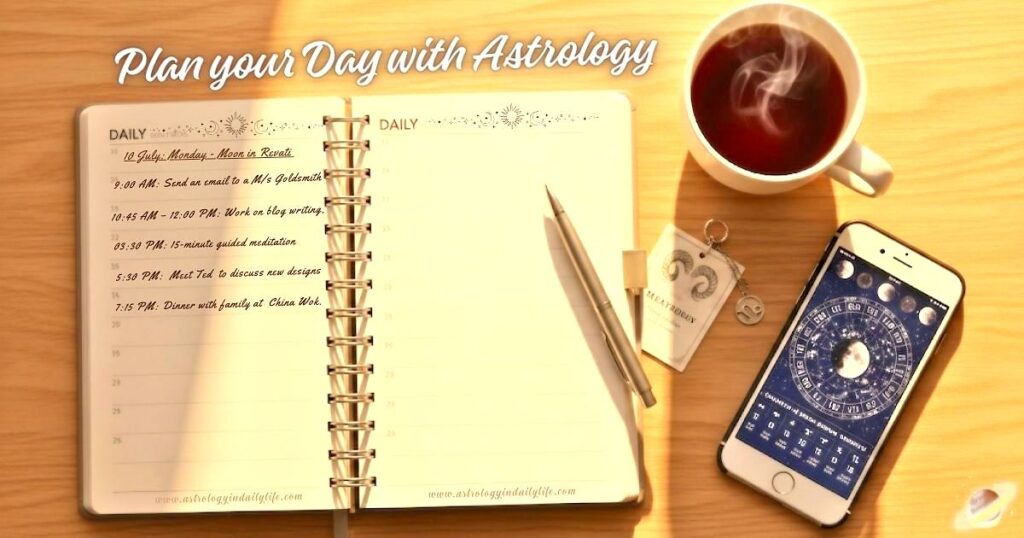
Ever felt like the whole day slips through your fingers despite you trying your best to stay organised? You are not alone. Life is chaotic and unpredictable, too! Unexpected things turn up at the last moment, plans change, distractions muddle up your schedule, and so on. But here’s something most people overlook: you can actually plan your day with astrology. Vedic astrology, in particular, offers practical and time-tested insights to bring structure, focus, and emotional balance into your daily routine. In this post, I will explore how simple astrological guidelines—like tracking the Moon’s movement—can help you plan and manage your day with more clarity and confidence. How Can I Start My Day with Purpose? Your emotional tone for the day is set by the Moon, which governs the mind and emotions. So, every morning: What Are the Best Strategies to Stay Organised? Your Ascendant (Lagna) has a significant impact on how you approach structure and time. If you do not know your ascendant, use your Sun sign as a guiding force. Plan your activities according to your sign: Fire signs (Aries, Leo, Sagittarius): Incorporate action-oriented tasks and creative outlets; brief, intense efforts are more effective than lengthy tasks. Water signs (Cancer, Scorpio, Pisces): Keep your planning straightforward and filled with positive emotions and intuitions. Earth signs (Taurus, Virgo, Capricorn): Break down large goals into smaller, practicable steps. Set aside time schedules in blocks and make tangible progress daily. Air signs (Gemini, Libra, Aquarius): Embrace flexibility when planning, focus on adaptability and engage in activities that stimulate the mind. How Do I Overcome Procrastination? Procrastination often links to your Saturn. A weak or afflicted Saturn shows where you feel stress and resistance and where procrastination tends to creep in. If you are constantly delaying things, check what house Saturn occupies in your chart. If Saturn is in the 6th or 10th house, you tend to be perfectionistic about work, which can make you feel pressured. Take the stress off and do the easiest part first. If Saturn is in the 1st or 12th house, then you may feel short on energy or be self-destructive. It is advisable to create a schedule which is gentler, not rigid. The BEST REMEDY is: Commit to doing something at the same time every day, even if only for 10 minutes. Respect your energy rhythms. Saturn rewards consistency, not speed. 6th house and Daily Planning: Your 6th house rules your daily routines and health. It specifies what sustains you energetically. Identify 1–2 essential commitments based on the planets/sign of the 6th house and plan accordingly: How Can I Set Achievable Goals? Your Sun sign and current dasha or transit will help you here. Your Sun represents your core aspirations and the aspects in which you can excel. But transits tell you when to push and when to pause. Vedic Astrology’s Daily Planner: Day Ideal For Monday Emotional work, introspection, intuitive planning, compassionate roles, reflection, nurturing loved ones, self-care Tuesday Taking action, problem-solving, execution of plans, assertive decisions, fitness, and taking bold steps Wednesday Discipline, responsibility, consistency, attention to detail, completing pending tasks, and long-term planning Thursday Growth, wisdom, long-term planning, teaching, healing, financial and spiritual matters Friday Love, beauty, luxury, money matters, creativity, self-care, harmony in relationships Saturday Discipline, responsibility, consistency, attention to detail, completing pending tasks, and long-term planning Sunday Leadership, visibility, confidence-building, setting targets, personal goals, health and relaxation. Conclusion: By understanding your chart and the daily movements of the Moon or planets through Vedic astrology, you gain insight into your inner self. Make sure to review the Moon’s sign and your top 3 priorities tomorrow morning and align at least one of them with what your chart supports emotionally and energetically. Let astrology be your daily compass Align Your Body with the Stars! Check out the best yoga pose for your zodiac sign 👉 Read: https://astrologyindailylife.com/astro-yoga-for-each-sign/
AKSHAYA TRITIYA: NEW BEGINNINGS, PROSPERITY AMPLIFIED

hink you know Akshaya Tritiya? Think again. Uncover the deeper meaning behind this powerful day of cosmic alignment and timeless abundance.
The Wealth Astrology Guide To Help You Get Rich.

We all have heard the famous quote: ‘Money is not everything but everything needs money.” One of the four aims of human life in Indian philosophy is Artha meaning acquisition of wealth and financial security. Goddess Lakshmi is the goddess of wealth, fortune, luxury, material fulfilment and contentment. She has been described as चंचला meaning unsteady and चपला meaning swift or restless. This indicates the unpredictable and inconsistent nature of wealth. Here, I shall analyse the role of Astrology in determining the financial status of a person and how it can help in overcoming monetary problems. Which house in astrology is for money? In astrology, conventionally four houses are very important to consider the financial status of a person, viz the 2nd, 5th, 8th and 11th houses. 2nd house shows one’s personal assets, savings and economic growth. This house hints at how the money will be earned. 5th house is for sudden gains and gains through speculation, lottery, etc. 8th house indicates personal assets accumulated through partnership and/or marriage, hidden deals, inheritance, etc. 11th house is for one’s personal assets accrued through self-efforts, business and career. This house indicates huge gains and high bracket income. The 9th house is also important as it is the house of luck and prosperity. It decides how fortune will treat you. In fact, the 5th and 9th houses are considered the houses of wealth (Lakshmi Sthana). The main Houses indicating financial issues such as debts, loans, losses, etc are the 6th, 8th, 11th & 12th Houses. Which planets are associated with money? The main planets associated with money are: Venus: Since Venus is the natural ruler of the 2nd house, its position is very important. The placement of Venus in a chart can reveal a lot about your ability to attract money. If placed in the 2nd or 8th house, it will give you substantial wealth. A weak Venus gives financial problems. Jupiter: Jupiter is the planet of fortune, luck, richness and expansion. Jupiter, if in the 2nd or 8th house, gives money through multiple and unexpected sources. Saturn: Saturn provides permanency and long-term potential to earn and retain wealth. Its placement in the 2nd or 8th house gives opportunities to earn money in a foreign land and helps in increasing savings. Mars: Mars in the 2nd house provides the energy and drive to earn money and gain wealth. While Mars in the 8th house gives unearned gains. However, it also makes one spend impulsively. Uranus (sudden wealth) and Pluto (God of Riches) with auspicious aspects from Venus and/or Jupiter can bring copious wealth. Some important planetary placements and combinations in the horoscope for wealth: A person with a strong placed Jupiter will never be empty-handed. A strong Moon too makes a person affluent. Moon+Mars conjunction also called ‘Laxmi Yoga’ blesses a person with wealth and fame. Uranus aspected by Venus gives sudden, unexpected wealth such as winning a lottery. People with a Venus-Jupiter connection in their horoscopes – be it by conjunction or aspect, never face any scarcity of money in their lives. Any connection between the 2nd lord and the 11th lord through placement, conjunction or aspect indicates enormous wealth. In fact, this is a very strong wealth-producing combination. It bestows the native with multiple gains. Sun in the second house of the horoscope can make a person a millionaire. A person with 2nd lord placed in the 5th house earns wealth through his wisdom and creativity. A person with 2nd lord in the 4th house is blessed with all kinds of comforts and luxuries. 5th lord in the 10th house or the 10th lord in the 5th house gives abundant wealth. The conjunction of the 5th and 9th lords or 9th and 10th lords also is a good combination for wealth. The presence of the 9th lord in the 11th house makes a person lucky in matters of wealth. If the 10th lord is placed in the 1st or 2nd house, the native’s wealth will keep increasing with time. If the 11th house contains or is aspected by auspicious planets, the native will never be short of money in his life. Rahu in the 11th house gives substantial gains without much sweat. The placement of Venus in the 12th house of the horoscope ensures a luxurious life. At the same time, the native should be careful when taking loans for their extravagant expenses. If there is any parivartan/exchange between the 2nd lord with the 5th lord or the 11th lord, the person earns a lot of money. It is essential that the above placements and combinations are not aspected or impacted by malefic planets. Now, let us discuss some remedies related to wealth. Remedies to attract wealth: “Kubera” is the god of wealth and the direction of Kubera is North. Hence place the locker in the North zone of the house. Keep the cash locker/cupboard adjacent to the south wall of the house such that it opens in the north direction. Do not take anything free of cost nor offer any of your services free of cost. Always make sure that you pay/receive some monetary compensation. Take a small piece of Parijat root and 11 white gunja seeds. Place them together in a small silver case or locket. Wear this locket to attract sudden wealth. If your income is unsteady or irregular, do this remedy. : Starting from the first Saturday of Shukla Paksha (bright period of phases of the moon), start distributing poori – sabji to the poor for 11 consecutive Saturdays. This will ensure a steady and continuous flow of income. Never return home empty-handed. Always get something – be it a flower or fruit or some snack. Never keep nor use any broken vessels in the house. Practical Remedies to get rid of finance-related problems: Salt remedy: If financial problems trouble you despite your great efforts, then do this remedy. Keep salt in a clay vessel in the northeast direction of your house. Keep changing the
ASTRO-YOGA: COSMIC GUIDANCE FOR MIND, BODY & SPIRIT

Yoga and astrology are both ancient practices that have been intertwined in various cultures and traditions. Certain yoga poses align well with the characteristics associated with astrological signs based on their elemental qualities (fire, earth, air, water) or characteristics associated with their signs. Yoga and astrology work in unison to align energies with cosmic forces and astrological patterns. Here are some yoga poses that are beneficial for different zodiac signs: Aries: Warrior I (Virabhadrasana I): Aries are known for their strong and determined nature. Warrior I builds strength and confidence, allowing Aries to channel their energy into focused action, build strength, and cultivate a sense of focus and determination, which aligns well with the sign’s characteristics. Mountain Pose (Tadasana): This pose helps Aries ground themselves and cultivate stability amidst their dynamic energy. This yoga pose is particularly beneficial for grounding and centring themselves. Tadasana helps cultivate awareness of breath, posture, and alignment, fostering a sense of harmony and balance. Taurus: Tree Pose (Vrikshasana): Taurus individuals appreciate stability and connection with nature. Vrikshasana is a fundamental standing yoga posture that helps improve balance, concentration, and strength. Tree Pose helps them to stay grounded and find balance and stability. Corpse Pose (Savasana): Savasana involves lying flat on the back, arms relaxed at the sides with palms facing up, and legs extended comfortably with feet falling outward. Taurus can fully relax and restore their energy in Savasana, allowing them to let go of tension and find deep inner peace. Gemini: Half Lord of the Fishes Pose (Ardha Matsyendrasana): Gemini individuals benefit from spinal twists to stimulate their curious minds, improve digestion, stimulate the abdominal organs and promote flexibility of the spine and hips. Additionally, it helps to relieve stiffness in the back and neck. Alternate Nostril Breathing (Nadi Shodhana): This breathing technique helps balance Gemini’s dual nature and calm their restless minds, enhancing focus, and potentially aiding in their ability to adapt to changing situations. Nadi Shodhana is particularly helpful for managing their dynamic and sometimes scattered energy, promoting focus, and enhancing mental agility. Cancer: Child’s Pose (Balasana): Cancer individuals seek comfort and emotional security. Child’s Pose allows them to surrender and release tension, nurturing their emotional well-being. It has calming, grounding and relaxing effects – much needed by the Cancerians. The practice of this asana improves mindfulness and body awareness. Moon Salutation (Chandra Namaskar): The Moon rules Cancer, so practising Moon Salutations helps them connect with their intuitive side and honour lunar energy. Each posture in the sequence corresponds to a phase of the Moon and is performed with mindful breathing. Leo: Lion’s Breath (Simhasana): Leo individuals express themselves with confidence and vitality. Lion’s Breath helps release pent-up energy and fosters self-expression. It is the roar that releases tension in the body as it stimulates and energizes the throat. The roar is not only a physical action but also a symbolic release of emotional tension. Sun Salutation (Surya Namaskar): The Sun rules Leo, and Sun Salutations help them embrace their fiery energy and awaken their inner strength. It strengthens the Sun in the birth chart, influencing self-respect, reputation, health and leadership qualities. Surya Namaskar helps in balancing the flow of prana (life force energy) throughout the body’s energy channels (Nadis). Virgo: Seated Forward Bend (Paschimottanasana): Virgo individuals value introspection and inner alignment. Seated Forward Bend promotes focus and balance while relieving tension and stiffness in the back, shoulders and neck. As one bends forward, the pose has a soothing effect on the mind, reducing stress and providing a sense of deep relaxation. Bridge Pose (Setu Bandhasana): Setu Bandhasana, also known as Bridge Pose, is an inverted back-bending asana in yoga. This pose helps Virgo individuals ground themselves and find stability while opening their heart and throat chakras. It helps enhance spinal flexibility and decompress the spine. Libra: Dancer’s Pose (Natarajasana): Libra individuals seek balance and harmony in all aspects of life. Dancer’s Pose cultivates grace and balance while opening the heart and expanding energy. It helps cultivate mindfulness and boost self-confidence. This Pose helps develop mindfulness and presence, fostering a deeper connection between mind and body. Partner Yoga Poses: Libra thrives on harmonious relationships, so practising Partner Yoga Poses fosters connection and mutual support. Partner yoga can help improve focus and concentration and help build stronger connections, friendships and social skills. You can perform poses like the Double Boat Pose, Double Tree Pose, Double Dancer Pose, Partner Wheel Pose, etc. Scorpio: Cobra Pose (Bhujangasana): Scorpions embrace transformation and renewal. Cobra Pose activates the spine and taps into its transformative energy. It stimulates blood circulation throughout the body, promoting cardiovascular health and boosting energy levels. Bhujangasana helps open up the heart centre and encourages the flow of energy throughout the body, which can help Scorpios manage their emotions and maintain balance. Warrior II (Virabhadrasana II): This pose strengthens the legs and opens the hips, helping to release tension and promote focus, which can be beneficial for Scorpio’s intense nature. It is a fantastic pose for summoning up emotional courage and mental resolve to face life’s battles. The pose encourages deep breathing and mindful awareness, which can help Scorpios navigate their emotions with greater ease. Sagittarius: Warrior Poses (Virabhadrasana I, II, III): These poses help build strength, focus, and confidence, which are qualities that align well with the adventurous and fearless nature of Sagittarius. Reflecting Sagittarius’s bold spirit, the Warrior Pose, embodies strength and courage akin to that of a warrior. Archer Pose (Akarna Dhanurasana): This
ALL YOU WANTED TO KNOW ABOUT MAKARA SANKRANTI

Meaning & Significance: Makara Sankranti is an important astrological and astronomical event in the Hindu calendar. The word ‘Makara’ means ‘Capricorn’ and ‘Sankranti’ means shifting (Sankramana) of the Sun from one zodiac sign to the next. It marks the end of the winter solstice and indicates the transition of the sun from the celestial sign of Dhanu (Sagittarius) to Makara (Capricorn) on its cosmic path. This is the day of the longest night and the shortest day. Makara Sankranti, being an event related to the movement of the Sun, is one of the few Indian festivals which falls on the same date nearly every year, viz. 14 (sometimes 15) January. This usually coincides with the first or second ‘tithi’ (date) of Krishna Paksha (Waning Moon) of the Hindu month of Magha. Hence, people take a holy dip in rivers on this occasion – also called ‘Magha Snana’. Makara Sankranti also marks the beginning of the auspicious period of ‘Uttarayana’ (also called the ‘day of the Gods’) – thereby indicating the beginning of a six month period of prosperity and good fortune. This event strikingly corresponds to the 6 month day at the North Pole after the winter solstice. The Sun starts moving northwards now – from the Tropic of Capricorn towards the Tropic of Cancer – and days start becoming longer and warmer. Makara Sankranti also marks the beginning of the Kumbha Mela and the end of the Sabarimala pilgrimage. Makara Sankranti is celebrated since the times of the Aryans. Even today people celebrate it in different parts of India in different ways and by different names. In the North Indian states of Punjab and Haryana, it is celebrated as the Lohri festival; as Magha Saaji in Himachal Pradesh. Uttar Pradesh celebrates it as the Khichdi festival; Bihar as Til Sankranti. It is called Pongal in Tamil Nadu, and Suggi in Karnataka; while in Assam, it is celebrated as Magh Bihu and Bhogal Bihu. Besides India, many other Asian countries like Bangladesh, Cambodia, Laos, Myanmar, Nepal, Sri Lanka and Thailand also celebrate Makara Sankranti in different forms. Beliefs & Legends: The lord of Makara (Capricorn) is Shanidev (Saturn). Suryadev (Sun) is the father of Saturn. Yet they are bitter adversaries of each other. However, on Makara Sankranti day, Sun God forgets his anger and animosity and visits his son – Saturn’s house. Hence the practice of distributing and eating ‘Til Gud’ – an Indian sweet made of sesame (representing Shani) and jaggery (representing Surya) started – representing the joyful and sweet bonding of adversaries. Sesame seeds play a very significant role in the celebration of Makara Sankranti due to their association with Saturn (Shani). For the same reasons, people purchase, wear and donate black clothes (which are otherwise considered inauspicious) on this day. We can also find evidence of the auspiciousness and significance of this festival in an incident of the epic story, Mahabharata. The grand old Bhishma Pitamah was lying fatally wounded on the battlefield. He had the boon of ‘Ichha Mrityu’ i.e. he could choose when to leave this mortal body. He waited for 58 days lying on a bed of arrows so that he could die on the auspicious day of when the Uttarayana began which is MAKARA SANKRANTI DAY. It is a belief that those who die during Uttarayana attain nirvana (redemption). Astrological Perspective: Makara (Capricorn) represents the tenth house of the astrological chart. The tenth house is the strongest Kendra or Angular House. Sun is one of the Karakas or significators of the tenth house where it also gets ‘Dig Bala’ (Directional Energy). Also, Saturn is one of the Karakas or significators of the tenth house. So when the Sun enters Capricorn, it is one Karaka/significator entering the house of another Karaka/significator. No wonder, this occurrence is very significant and propitious. This event symbolizes the combination of energy, vigour, and leadership attributes of the Sun with the practicality, focused concentration, thoughtfulness and patience of Saturn. Significance of donation during Makara Sankranti: Rituals and customs of celebrating Makara Sankranti may vary from region to region. But the common feature underlining celebrations everywhere is the importance of Japa-Tapa-Snana-Dana-Tarpan (Chanting-Meditation-Holy Bath-Donations-Offerings to the deceased ancestors). The Shastras mention that the Gods wake up on this day after 6 months of sleep. (1 day of Gods = 6 terrestrial months). Hence it’s the time for new auspicious beginnings and celebrations. Hence people make offerings to the Sun – the life-giver. It is a strong belief that whatever is donated on this day comes back multifold. The logic behind this is to let everyone partake in prosperity and abundance. Benefits of Donation: Donations not only help one to earn blessings but also help to mitigate the adverse effects of the malefic planets in the person’s Kundli (Birth Chart). Anyone who is facing problems due to adverse Sun or Saturn, who is undergoing Sade Sati or Shani Dhaiyya or Panouti or the Dasha of Sun/Saturn, Pitra Dosha, Kaal Sarpa Dosha shall benefit by donating the related things on this day. Childless couples can benefit by fasting on this day and donating til (sesame seeds) and til products after offering water to the Sun. Those facing serious or multiple problems in their lives – be it mental, physical or financial- can do Tula daan on this day i.e. donate articles equivalent to their body weight. Cleansing oneself before making offerings is also obligatory. Hence people take a dip in the holy waters of Ganga, Yamuna or whichever local river is there in the vicinity. Those who do not have access to rivers mix sesame seeds and Gangajal in their bathing water. It is best to make the offerings to a needy person/s. Gold, ghee (Clarified butter), sesame seeds, cow, cow/ox, blankets, clothes, and jaggery are the main items to donate on this day. Another very important thing donated and distributed is ‘Khichdi’ – a mixture of rice, lentils and vegetables. Recommended donations for different