

SIMPLE REMEDIES FOR PITRA DOSHA IN A HOROSCOPE
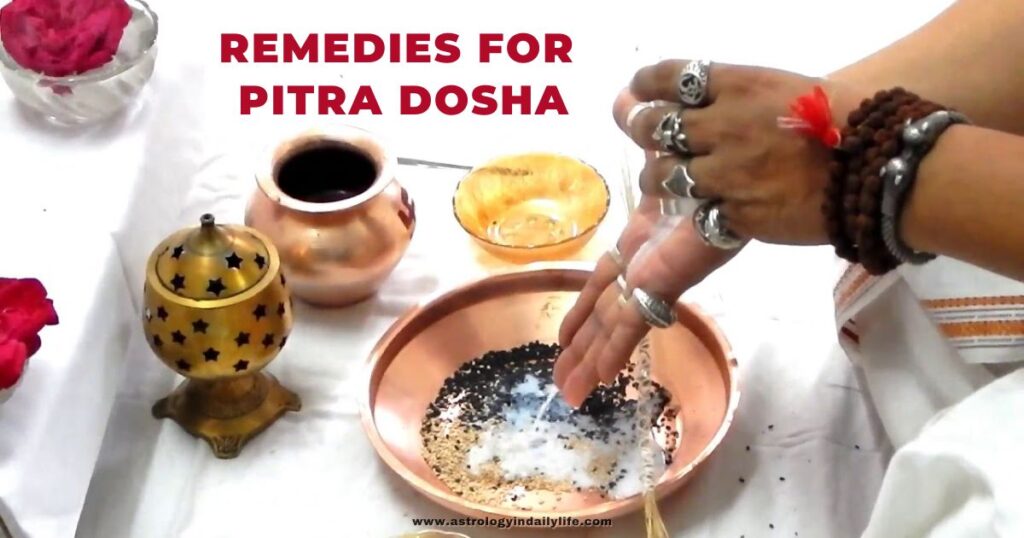
Pitra Dosha in Vedic astrology refers to ancestral karma or unresolved issues passed down from forefathers. It occurs when there is a disturbance in the family lineage or when the ancestors’ wishes remain unfulfilled. Various combinations of planets in a horoscope lead to the formation of Pitra Dosha, often associated with curses from someone who was physically, financially, or emotionally harmed in the past. This can create a repeated pattern of suffering within the family. Those afflicted by Pitra Dosha may face obstacles in areas like health, relationships, and finances, often leading to depression and challenges on multiple fronts. Remedies typically involve honouring ancestors, performing specific rituals, or charitable acts to balance the energy and bring peace to the family lineage. Hence, here we present some simple remedies to help you mitigate the malefic effects of Pitra Dosha: Evade actions that might harm others physically, financially, or emotionally, as this could perpetuate negative karmic patterns. Avoid anger and egoistic behaviour at all costs. Be grateful and humble. This in itself is the best remedy to minimize the ill effects of Pitru Dosha. Serving and respecting your living elders can bring blessings and reduce Dosha effects by balancing familial relations. Resolving long-standing family disputes or misunderstandings can help clear negative ancestral energies. Offer unconditional and unannounced services to elderly needy persons, menial workers, poor people and animals. Regular donations, particularly for education, healthcare, or spiritual causes, can help balance the karmic energy. Contribute to the expenses of getting a poor girl married. You can also contribute to the treatment of poor patients. Collect an equal amount of money from all your relatives and donate it to a holy place, such as a temple, on Amavasya. You can also donate white-coloured clothes, curds, radishes and money on Amavasya. Make balls of cooked rice and ghee and feed these balls to crows and fish every Saturday. Offer water (if possible, Gangajal), janeu thread and black sesame seeds to the roots of the Peepal trees every Saturday. Perform circumambulation (परिक्रमा) of the tree 108 times reciting the mantra “Aum Namo Bhagvate Vaasudevaaye” – “ॐ नमो भगवते वासुदेवाय”. Planting trees, especially fruit-bearing ones, in memory of ancestors is believed to bring blessings and relieve Pitra Dosha. For a simpler remedy, water the Peepal tree every morning and light a lamp with sesame oil near its roots every evening. Plant a Peepal plant on an Ekadashi and donate rice or products made of rice. Make sure to burn camphor (कर्पूर) at home every morning and evening. This pacifies Pitra Dosh. You should recite the Gayatri Mantra daily. Hang/place the pictures of your late relatives/ancestors on the southern wall of the house. Seek their blessings every day. Whenever you visit any religious place, offer 3 palm-full of water to your ancestors (Pitrus) while bathing in the holy pond/river. SOME OTHER REMEDIES: Light a lamp in the evening. Recite Nag Stotra, Maha Mrityunjaya Mantra or Rudra Sukta or Navagraha Stotra. This will appease the souls of the departed. Narayan Nagbali Pooja is a special ritual for Pitra Dosha. This pooja becomes important when any ancestor has died an abnormal, unnatural or untimely death. One can do this pooja at Trimbakeshwar at Nashik, Chandod in Gujarat, Kalahasti in Andhra Pradesh or at Haridwar in Uttarakhand. It is a well-known belief that when one recites the 11th chapter of Shrimad Bhagwat Geeta, the ancestors appear in one’s dreams. Presently, they let the person know whether they are satisfied or not. Furthermore, they also give indications as to what they need for their salvation. You can recite the Pitra Dosha Shanti Mantra one mala (rosary) daily: “Om Shreem Sarva Pitra Dosha Nivaranay klesham Han Han Sukh Shantim Dehi Phat Swaha”. After completion, donate some food to Brahmins or cows. Perform Rudrabhishek: This is a special prayer and ritual dedicated to Lord Shiva, which can be performed at a temple to bring peace to ancestors and lessen Dosha effects. Click HERE to read all that you wanted to know about PITRA DOSHA.
KNOW THE SIGNIFICANCE OF PITRA PAKSHA
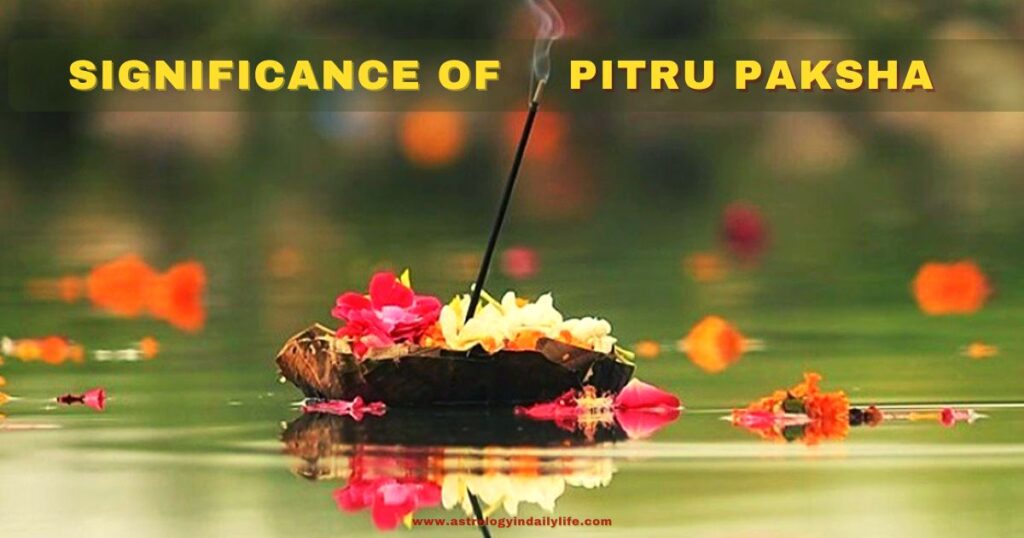
Pitru Paksha literally the ‘fortnight for the Ancestors‘. Pitru Paksha, also known as Mahalaya Paksha, is a 16-day period in the Hindu lunar calendar dedicated to paying homage to one’s ancestors or pitrs. Almost every culture in the world honours its dead ancestors. For instance, the Japanese Buddhists observe Bon-Odori where families come together to welcome their ancestral spirits. Mexicans observe Dia de los Muertos or the Day of the Dead. Furthermore, Halloween, or All Hallow’s Eve, is a celebration specifically for remembering the dead, the saints, martyrs, and all other faithfully departed. In fact, in Chinese culture, there is an entire month called ‘ghost month’ which is dedicated specifically to honouring their ancestors. Likewise, in India, too, Hindus have a period of paying homage to their departed ancestors. This period of 16 days is called Pitru Paksha – ‘Pitru’ means Ancestors and ‘Paksha’ means a fortnight. Thus, the sixteen days of the Hindu month of Bhadrapada is Pitru Paksha. This Paksha begins on Purnima – Full Moon Day and ends on Amavasya – No Moon Day. The last day – ‘Sarva Pitri Amavasya‘ or the ‘Mahalaya Amavasya’ – is a day for honouring all the ancestors. This year, Pitru Paksha starts on 07 September 2025 and ends on 21 September 2025. Pitru Paksha is not a time for celebrations. It is, in fact, a fervent period earmarked for remembering the departed ancestors and performing special rites for the salvation of their souls. Hindus believe that during the Pitru Paksha, their deceased ancestors leave their abode, Pitru Lok (Land of the Dead) and descend on Prithvi Lok viz the Earth. In Mahabharata, when the legendary Karna reached heaven after death, he was offered food made of solid gold. In his lifetime, he was famous as ‘Daanveer’ due to his bigheartedness and generous nature. He complained to Lord Indra that he was very hungry and obviously, could not eat gold. Indra smiled and reminded him that though he offered a lot of gold in charity when alive, he never provided any food to his ancestors or performed the Shraddha ceremony. Karna realized his mistake. He requested that Lord Indra give him one chance to return to Earth and correct his mistake. Thereby, Lord Indra granted him his wish. Karna returned to Earth and fed the poor for 16 days. This was the period of Pitru Paksha. There are three main rituals of Pitru Paksha – Tarpan, Shraadh and Pind Daan. ‘Trup’ which means satisfaction is the root word of the word ‘Tarpan’. Thus, Tarpan means paying oblations to Gods, Sages and ancestors by offering water to satisfy them with Black sesame (til) seeds mixed in it. One should perform this ritual while standing in a river or a water body. Tarpan for the deceased ancestors is performed facing south. A ring made of dried Kusha or Durva grass is worn on the finger while performing the ritual. ‘Pind Daan’ is another ritual performed along with Shraddha. This involves making an offering of ‘Pindis’. Pindis are balls of cooked rice and barley with black sesame seeds, cow’s milk, honey, sugar and ghee. Pind Daan is usually done either on a silver plate or a leaf. The word ‘Shraddha’ has originated from ‘Shraddha’ (faith). Shraddha is the ritual of offering food to the priests (Brahmins). While feeding the priests one expresses his gratefulness to his ancestors through them. Besides food, one can also distribute clothes and money to the Brahmins and the poor. Hindus believe that crows are messengers of Yama, the God of Death. Any food fed to the crows directly satiates the ancestors’ spirit. According to the Puranas, the crows had tasted the nectar, Amrit – which made them immortal. Even today, it is widely believed that no crow dies its natural death. It dies only sudden death due to an attack or accident. Incidentally, both crows and the Peepal (Sacred Fig) tree represent the Pitrus – the dead ancestors. Hence, feeding crows and watering the Peepal tree are important rituals of Pitru Paksha. Besides the crows, there is also a custom of feeding cows, dogs, ants and beggars during Pitru Paksha. Brahma Kapal Ghat, Badrinath Haridwar in Uttarakhand Dev Prayag in Uttarakhand Trimbakeshwar in Nashik, Maharashtra Bharat Kund in Ayodhya, Uttar Pradesh Vishranti Tirth in Mathura, Uttar Pradesh Assi Ghat and Manikarnika Ghat in Varanasi, Uttar Pradesh Triveni Samgam in Allahabad, Uttar Pradesh Naimishaaranya in Uttar Pradesh Narmada Ghat in Jabalpur, Madhya Pradesh Avantika, Kshipra Ghat in Madhya Pradesh Pehova in Kurukshetra, Haryana Pushkar in Ajmer, Rajasthan Matrugaya Kshetra, Siddhpur in Patan, Gujarat Dwarka in Jamnagar, Gujarat Gaya Ghat in Bihar Jagannath Puri in Orissa Tirupati in Tamil Nadu Firstly, the food prepared is Sattvic – ie without onion and garlic. Non-vegetarian food is strictly prohibited. Furthermore, one should avoid root vegetables like potatoes, sweet potatoes, colocasia, radish, carrots, etc, and vegetables like eggplants, tomatoes, cabbage, and drumsticks. Even strong spices should be avoided. Usually, the preferred sattvic dishes include Urad dal vadas, rice kheer or payasam, seasonal vegetables like all types of gourd, raw plantains, ladyfinger, green beans, dals, leafy vegetables, seasonal fruits, etc. Also, it is best to serve food is on banana leaves. After preparing the food, keep aside food for cow, dog and crow. Thereafter, offer food to Brahmins (priests) and needy people. Only after they have been satisfactorily fed, can the family members consume the food. To read about REMEDIES FOR PITRA DOSHA IN A HOROSCOPE, click HERE What should you do during Pitra Paksha? What should you NOT do during Pitra Paksha? Make donations and offer food and clothes to the needy in the name of your ancestors. Donation of black sesame seeds is auspicious. Regularly chant Mantras like the Maha Mrityunjaya Mantra and Gayatri Mantra. Show respect and humility towards elders and ancestors. Feed animals like dogs, cows and crows. If possible, visit pilgrimage sites