

PITRA DOSHA IN HOROSCOPE AND ITS EFFECTS

ALL YOU WANTED TO KNOW ABOUT PITRA DOSHA ‘Dosha’ in Astrology indicates unfavourable planetary placements or combinations in one’s horoscope. There are different types of Doshas – Mangal Dosha, Kaal Sarpa Dosha, Shraapit Dosha, etc. All the Doshas represent Past Life Karmic Debts. In 2025, Pitru Paksha will begin on September 07 and will conclude on September 21. WHAT IS PITRA DOSHA? Pitra Dosha is one of the most dreaded doshas in a horoscope. This dosha is also one of the most misunderstood of all the doshas. Pitra Dosha represents unresolved ancestral issues that manifest as recurring problems in life. It serves as a symbolic reminder of the emotional and karmic bonds we share with our ancestors. It is commonly believed that Pitru Dosha is a curse of the ancestors upon the person in whose horoscope it appears. This is NOT the case. Pitru Dosha indicates a curse on the ancestors! (Exception: See point 4 under COMBINATIONS forming Pitru Dosha) The native having Pitra Dosha has to repay the karmic debts of his ancestors. Yes, he has to pay for the karma of his ancestors. You may ask: Why should a person suffer for the deeds of others? Just as a person inherits genes, genetic problems, wealth, properties, qualities, etc. from his ancestors, in the same way, he inherits the karmic debts of his descendants. Generally, we are born among the same family/friend circle through many births as we have karmic debts to clear. Many times, the same ancestor takes rebirth in the same family as a grandson or great-grandson. In such a case, he has to repay for the deeds he did in his earlier birth/s. If he had acted in some malicious manner or indulged in criminal activities thereby hurting others physically/mentally in any manner, then in his successive birth, he is born with Pitru Dosha in his horoscope. He will obviously have to bear the fruits of his earlier wrongdoings. This will continue till the time his suffering equals the sorrow he had caused to others. Alternatively, he can balance out his karmic debt by doing good deeds, being patient, and appropriately serving people. For example, if he had hurt his parents at an earlier birth, he should not be extra patient and respectful towards them. Pitru Dosha may occur if any of the ancestors up to the 7th generation on the patriarchal side and up to the 4th generation on the matriarchal side have died an early or unnatural death or have intense pending karma. The 9th house in a horoscope represents our ancestors -our forefathers. It also represents our Dharma – our duty towards our ancestors. Also, the 4th house represents our mother as well as foremothers and other female ancestors. Among the planets, Pitru Dosha can be formed due to any planet which is malefic in the horoscope. But of all, Rahu (North Node)/Ketu (South Node) have the most important roles to play. Malefic planets, when associated with the 9th house or 9th house lord (9th house/lord from Ascendant/Moon), indicate exasperated desires of the ancestors’ soul. Hence, whenever malefic planets or lords of 6/8/12th houses in conjunction or aspect affect the 9th house or the 9th house lord, it definitely forms Pitru Dosha Yog. Brahat Parashar Hora Shastra (BPHS) mentions 14 different kinds of Pitru-dosha. In general, Rahu or Ketu conjunct with the luminaries, Sun and Moon and placed in the 6/8/12th houses form strong Pitra Dosha. The conjunction of Sun+Rahu or Sun+Saturn in the 1/2/4/5/7/9/10th houses results in Pitra Dosha. For example, when Sun+Rahu sits in the seventh house, the person may find it difficult to get married. Or if married, his life will be full of disturbances and dissension. Sun conjunct Rahu when in 10th house cause hurdles in career and professional life. Sun and Rahu placed together in the 9th house indicate a strong Pitra Dosh. Furthermore, if the Sun is debilitated, the malefic results shall be more pronounced. When any malefic planet is placed in the 9th house or affects the lord of the 9th house, it forms Pitru Dosha. The Malefic Sun placed in the 9th house is Pitra Dosha, indicating suffering due to the curse of the ancestors. The placement of Venus, Saturn and Rahu, or two of these three in the 2nd, 5th, 9th or 12th House of the horoscope indicates PitruDosha. Mercury or Ketu or both situated in the 1st or 8th House in the horoscope result in the formation of Pitru Dosha. If the Ascendant lord is placed in the 6/8/12th houses and Rahu is placed in the Ascendant, then too Pitru Dosha is formed. Weak/debilitated Ascendant afflicted with Rahu+Saturn conjunction. Jupiter afflicted by malefic planets (Saturn, Rahu or Ketu) and placed in the 9th house of the horoscope creates Pitru Dosha. When Rahu, Saturn or Mars afflict Venus, then too it results in Pitra Dosha. Even if one does not know Astrology, there are some indicators and signs which can signal the presence of Pitra Dosha in your horoscope. To read about them, click HERE. When Pitra Dosha exists in a horoscope, the person suffers even when he is honest, good and upright. In fact, the person often wonders what wrong he has done to undergo so much misery and anguish. Pitru Dosha results in an unfavourable environment in the family. The intensity of the results depends upon the severity of the combination of the planets. Pitra dosha results in constant stress and tension, obstructions in education or career, etc. The person may experience a lack of progress and growth despite hard work, never-ending legal conflicts, etc. It leads to delayed and/or unsuccessful marriages. Women afflicted with Pitra Dosha may face problems in getting a child and repeated abortions. Illnesses, accidents, never-ending debts, etc., are other possible outcomes of Pitru Dosha.
KNOW THE SIGNIFICANCE OF PITRA PAKSHA
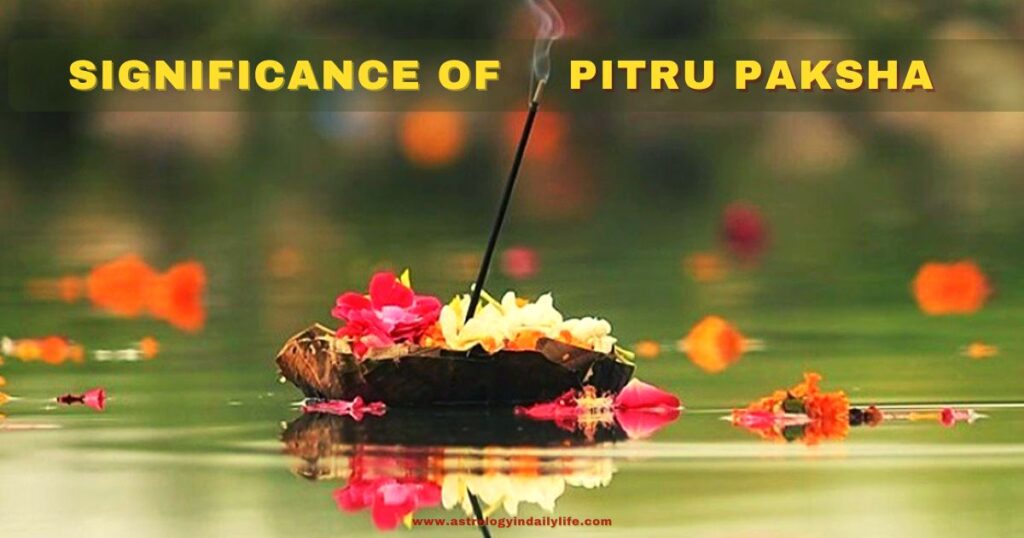
Pitru Paksha literally the ‘fortnight for the Ancestors‘. Pitru Paksha, also known as Mahalaya Paksha, is a 16-day period in the Hindu lunar calendar dedicated to paying homage to one’s ancestors or pitrs. Almost every culture in the world honours its dead ancestors. For instance, the Japanese Buddhists observe Bon-Odori where families come together to welcome their ancestral spirits. Mexicans observe Dia de los Muertos or the Day of the Dead. Furthermore, Halloween, or All Hallow’s Eve, is a celebration specifically for remembering the dead, the saints, martyrs, and all other faithfully departed. In fact, in Chinese culture, there is an entire month called ‘ghost month’ which is dedicated specifically to honouring their ancestors. Likewise, in India, too, Hindus have a period of paying homage to their departed ancestors. This period of 16 days is called Pitru Paksha – ‘Pitru’ means Ancestors and ‘Paksha’ means a fortnight. Thus, the sixteen days of the Hindu month of Bhadrapada is Pitru Paksha. This Paksha begins on Purnima – Full Moon Day and ends on Amavasya – No Moon Day. The last day – ‘Sarva Pitri Amavasya‘ or the ‘Mahalaya Amavasya’ – is a day for honouring all the ancestors. This year, Pitru Paksha starts on 07 September 2025 and ends on 21 September 2025. Pitru Paksha is not a time for celebrations. It is, in fact, a fervent period earmarked for remembering the departed ancestors and performing special rites for the salvation of their souls. Hindus believe that during the Pitru Paksha, their deceased ancestors leave their abode, Pitru Lok (Land of the Dead) and descend on Prithvi Lok viz the Earth. In Mahabharata, when the legendary Karna reached heaven after death, he was offered food made of solid gold. In his lifetime, he was famous as ‘Daanveer’ due to his bigheartedness and generous nature. He complained to Lord Indra that he was very hungry and obviously, could not eat gold. Indra smiled and reminded him that though he offered a lot of gold in charity when alive, he never provided any food to his ancestors or performed the Shraddha ceremony. Karna realized his mistake. He requested that Lord Indra give him one chance to return to Earth and correct his mistake. Thereby, Lord Indra granted him his wish. Karna returned to Earth and fed the poor for 16 days. This was the period of Pitru Paksha. There are three main rituals of Pitru Paksha – Tarpan, Shraadh and Pind Daan. ‘Trup’ which means satisfaction is the root word of the word ‘Tarpan’. Thus, Tarpan means paying oblations to Gods, Sages and ancestors by offering water to satisfy them with Black sesame (til) seeds mixed in it. One should perform this ritual while standing in a river or a water body. Tarpan for the deceased ancestors is performed facing south. A ring made of dried Kusha or Durva grass is worn on the finger while performing the ritual. ‘Pind Daan’ is another ritual performed along with Shraddha. This involves making an offering of ‘Pindis’. Pindis are balls of cooked rice and barley with black sesame seeds, cow’s milk, honey, sugar and ghee. Pind Daan is usually done either on a silver plate or a leaf. The word ‘Shraddha’ has originated from ‘Shraddha’ (faith). Shraddha is the ritual of offering food to the priests (Brahmins). While feeding the priests one expresses his gratefulness to his ancestors through them. Besides food, one can also distribute clothes and money to the Brahmins and the poor. Hindus believe that crows are messengers of Yama, the God of Death. Any food fed to the crows directly satiates the ancestors’ spirit. According to the Puranas, the crows had tasted the nectar, Amrit – which made them immortal. Even today, it is widely believed that no crow dies its natural death. It dies only sudden death due to an attack or accident. Incidentally, both crows and the Peepal (Sacred Fig) tree represent the Pitrus – the dead ancestors. Hence, feeding crows and watering the Peepal tree are important rituals of Pitru Paksha. Besides the crows, there is also a custom of feeding cows, dogs, ants and beggars during Pitru Paksha. Brahma Kapal Ghat, Badrinath Haridwar in Uttarakhand Dev Prayag in Uttarakhand Trimbakeshwar in Nashik, Maharashtra Bharat Kund in Ayodhya, Uttar Pradesh Vishranti Tirth in Mathura, Uttar Pradesh Assi Ghat and Manikarnika Ghat in Varanasi, Uttar Pradesh Triveni Samgam in Allahabad, Uttar Pradesh Naimishaaranya in Uttar Pradesh Narmada Ghat in Jabalpur, Madhya Pradesh Avantika, Kshipra Ghat in Madhya Pradesh Pehova in Kurukshetra, Haryana Pushkar in Ajmer, Rajasthan Matrugaya Kshetra, Siddhpur in Patan, Gujarat Dwarka in Jamnagar, Gujarat Gaya Ghat in Bihar Jagannath Puri in Orissa Tirupati in Tamil Nadu Firstly, the food prepared is Sattvic – ie without onion and garlic. Non-vegetarian food is strictly prohibited. Furthermore, one should avoid root vegetables like potatoes, sweet potatoes, colocasia, radish, carrots, etc, and vegetables like eggplants, tomatoes, cabbage, and drumsticks. Even strong spices should be avoided. Usually, the preferred sattvic dishes include Urad dal vadas, rice kheer or payasam, seasonal vegetables like all types of gourd, raw plantains, ladyfinger, green beans, dals, leafy vegetables, seasonal fruits, etc. Also, it is best to serve food is on banana leaves. After preparing the food, keep aside food for cow, dog and crow. Thereafter, offer food to Brahmins (priests) and needy people. Only after they have been satisfactorily fed, can the family members consume the food. To read about REMEDIES FOR PITRA DOSHA IN A HOROSCOPE, click HERE What should you do during Pitra Paksha? What should you NOT do during Pitra Paksha? Make donations and offer food and clothes to the needy in the name of your ancestors. Donation of black sesame seeds is auspicious. Regularly chant Mantras like the Maha Mrityunjaya Mantra and Gayatri Mantra. Show respect and humility towards elders and ancestors. Feed animals like dogs, cows and crows. If possible, visit pilgrimage sites
SPECIAL REMEDIES TO BE DONE ON DIWALI
DIWALI has special significance for doing and initiating astrological remedies. Let’s understand why? ASTROLOGICAL SIGNIFICANCE OF DIWALI: Diwali falls on Amavasya – Sun and Moon – the two luminaries and important astrological planets that come together this day are placed in Tula (Libra) Rashi and Swati Nakshatra. The evil spirits and negative energies are said to be strongest on Amavasya or No Moon day. Hence, stronger remedies or upaay which are done on this day are effective in warding off such strong negativity from one’s life. The Libra sign is a sign of balance and righteousness, of trade and business, of peace and harmony. Swati Nakshatra represents freedom, self-confidence and learning. Above all, it represents Goddess Saraswati – all forms of arts, communication, knowledge, etc. Swati is an auspicious Nakshatra. It helps one to accomplish the most difficult tasks and to move ahead, overcoming obstacles. The following remedies can be done/initiated on Diwali for maximum results: Tie a toran made of Asoka leaves and marigold (गेंदा) flowers at the entrance. This helps remove negativity in your house or commercial space. In case you are facing severe problems in your life, do this remedy. On Diwali night, light a lamp (दीपक) under a peepal tree after sunset. After lighting the lamp, walk back home without looking back and without uttering a word. This is a very good remedy, especially for those under Sade Sati or those having Shani Dosha. This, in essence, is a very effective remedy for those facing financial problems. Take three gomati chakra, three yellow cowries and three turmeric knots (हल्दी की गांठ). Tie them in a yellow cloth. Place this at the pooja place on Diwali night and thereafter keep it in your locker or cash box. 4. This remedy is for those who are suffering from some speech disorders, such as stammering. Take 11 cowries and burn them to ash on Diwali. Immerse this ash in flowing water. Continue for 5 consecutive Wednesdays. Don’t forget to light a diya in the southwest corner of your house. Moreover, this is an important Vastu tip. This is a valuable remedy for those who fail to get a good job even after repeated attempts. On Diwali, early morning (before sunrise), go to a crossroad (चौराहा) – where four roads meet with a lemon and a knife. Once you reach there, cut the lemon into four pieces; throw a piece in each direction; all the time mentally repeating your wish for a good job. After this, return without looking back even once. You can continue this for 7 consecutive days for the best results. If your business is not doing well or you are not getting a good flow of customers, try this remedy. Establish the Indrani yantra at your pooja or workplace on Diwali night. Surely, you shall see quick results. Those who have Chandra Grahan yoga or Angarak yoga in their horoscopes should not venture out of the house on Diwali night. On Diwali night, take the root of the banyan tree (बरगद की जड़) and a silk thread. Colour the thread with red sandalwood paste. Thereafter, tie the banyan root with the coloured silk thread at the main door of your residence or commercial premises after Laxmi puja. This remedy is for those eligible males and females who want to get married. Then place 11 marigold flowers on the altar, while doing pooja on Diwali night. Worship it with saffron (केसर)/turmeric (हल्दी) and place a ghee lamp in front of it (not too close), the whole night. Thereafter, in the morning, grind the flowers with Gangajal and saffron or turmeric. Apply this paste to your hands. Continue applying for 2-3 days or till the paste lasts. On Diwali night, burn camphor and clove in a silver or earthen vessel at the pooja place without fail. This will help ward off any problems related to spirits, bad omens, and all types of Vastu Dosha. Moreover, this remedy is a must, especially when anyone in the house has pitra dosha. WISHING YOU ALL A VERY HAPPY DIWALI Click here to read DIWALI REMEDIES ACCORDING TO YOUR RASHI/BIRTH SIGN (in Hindi)