

SIMPLE VAASTU TIPS FOR EAST DIRECTION

Vaastu Shastra evolved during the Vedic period in India. It is a part of the Atharva Veda. Vaastu Shastra is a science as well as an art. It endeavours to harness the energies of the Panch Tatwas viz the five essential elements of nature which are applied in architecture and home designing. The basic purpose and principle of Vaastu Shastra are to help human beings live healthy, prosperous and balanced life. VAASTU & ASTROLOGY: Vaastu is one of the important limbs of Vedic Astrology. Just as Astrology considers nine planets; so also there are nine directions in Vaastu. Each planet is assigned a particular direction. If you visit a Hindu temple, you will notice that idols of the navagrahas ie. the 9 planets are placed facing the directions that they rule. DIRECTIONS IN VAASTU: The nine directions considered in Vaastu are East, West, North, South, North-East, North-West, South-East, South-West and the Central part also known as Brahma Sthala. Each direction has a specific significance. Every direction is ruled by a specific diety and is dominated by a particular tatwa or element. It is only when the five elements are in perfect harmony that life moves in a balanced and harmonious manner. HERE ARE SOME IMPORTANT VAASTU TIPS RELATED TO THE EAST CORNER OF THE HOUSE: SUN RULES THE EAST (पूर्व दिशा). The Sun is the giver of life and health. Hence it is important that sun rays should enter abundantly in the Eastern direction of a house. East is the direction of prosperity and success. Hence it is advisable to sit and pray in the east direction. The altar for prayers/pooja should be along the East wall. The East corner is ideal for having the main door of the house. One can also have balconies in this area. Maximum number of windows should be provided on the Easterm direction. It is preferable to have large doors and windows in the East corner of the house. The East corner of the house should be lower than the South and the West corners. Children who study in the room situated in the Eastern side of the house are able to grasp things better and remember the lessons learnt for a longer period of time. One should always keep the Eastern corner very clean. Accumulation of dirt or clutter in the East corner may result in problems in begetting a progeny or some problems related to children. It is not advisable to construct toilets on the eastern side of the house. However, you can have a bathroom here. Mirrors put up in this direction double up the amount of prosperity one gets. Keeping green colored things or having a small garden in the Eastern direction of the house enhances Luck. The Eastern direction is also related to the Wood element. Hence, having some wooden furniture here would increase the vibrant energy of this direction. Do not place dust bins in the east direction. To read: VAASTU TIPS for WEST direction, click HERE.
SPECIAL REMEDIES TO BE DONE ON DIWALI
DIWALI has special significance for doing and initiating astrological remedies. Let’s understand why? ASTROLOGICAL SIGNIFICANCE OF DIWALI: Diwali falls on Amavasya – Sun and Moon – the two luminaries and important astrological planets that come together this day are placed in Tula (Libra) Rashi and Swati Nakshatra. The evil spirits and negative energies are said to be strongest on Amavasya or No Moon day. Hence, stronger remedies or upaay which are done on this day are effective in warding off such strong negativity from one’s life. The Libra sign is a sign of balance and righteousness, of trade and business, of peace and harmony. Swati Nakshatra represents freedom, self-confidence and learning. Above all, it represents Goddess Saraswati – all forms of arts, communication, knowledge, etc. Swati is an auspicious Nakshatra. It helps one to accomplish the most difficult tasks and to move ahead, overcoming obstacles. The following remedies can be done/initiated on Diwali for maximum results: Tie a toran made of Asoka leaves and marigold (गेंदा) flowers at the entrance. This helps remove negativity in your house or commercial space. In case you are facing severe problems in your life, do this remedy. On Diwali night, light a lamp (दीपक) under a peepal tree after sunset. After lighting the lamp, walk back home without looking back and without uttering a word. This is a very good remedy, especially for those under Sade Sati or those having Shani Dosha. This, in essence, is a very effective remedy for those facing financial problems. Take three gomati chakra, three yellow cowries and three turmeric knots (हल्दी की गांठ). Tie them in a yellow cloth. Place this at the pooja place on Diwali night and thereafter keep it in your locker or cash box. 4. This remedy is for those who are suffering from some speech disorders, such as stammering. Take 11 cowries and burn them to ash on Diwali. Immerse this ash in flowing water. Continue for 5 consecutive Wednesdays. Don’t forget to light a diya in the southwest corner of your house. Moreover, this is an important Vastu tip. This is a valuable remedy for those who fail to get a good job even after repeated attempts. On Diwali, early morning (before sunrise), go to a crossroad (चौराहा) – where four roads meet with a lemon and a knife. Once you reach there, cut the lemon into four pieces; throw a piece in each direction; all the time mentally repeating your wish for a good job. After this, return without looking back even once. You can continue this for 7 consecutive days for the best results. If your business is not doing well or you are not getting a good flow of customers, try this remedy. Establish the Indrani yantra at your pooja or workplace on Diwali night. Surely, you shall see quick results. Those who have Chandra Grahan yoga or Angarak yoga in their horoscopes should not venture out of the house on Diwali night. On Diwali night, take the root of the banyan tree (बरगद की जड़) and a silk thread. Colour the thread with red sandalwood paste. Thereafter, tie the banyan root with the coloured silk thread at the main door of your residence or commercial premises after Laxmi puja. This remedy is for those eligible males and females who want to get married. Then place 11 marigold flowers on the altar, while doing pooja on Diwali night. Worship it with saffron (केसर)/turmeric (हल्दी) and place a ghee lamp in front of it (not too close), the whole night. Thereafter, in the morning, grind the flowers with Gangajal and saffron or turmeric. Apply this paste to your hands. Continue applying for 2-3 days or till the paste lasts. On Diwali night, burn camphor and clove in a silver or earthen vessel at the pooja place without fail. This will help ward off any problems related to spirits, bad omens, and all types of Vastu Dosha. Moreover, this remedy is a must, especially when anyone in the house has pitra dosha. WISHING YOU ALL A VERY HAPPY DIWALI Click here to read DIWALI REMEDIES ACCORDING TO YOUR RASHI/BIRTH SIGN (in Hindi)
POWERFUL VAASTU TIPS FOR NORTH-WEST DIRECTION
VAASTU: Vaastu Shastra evolved during the Vedic period in India. It is a part of the Atharva Veda. Vaastu Shastra is a science as well as an art. It endeavours to harness the energies of the Panch Tatwas viz the five essential elements of nature which play a vital role in architecture and home designing. The basic purpose and principle of Vaastu Shastra are to help human beings live a healthy, prosperous and balanced life. VAASTU & ASTROLOGY: Vaastu is a vital aspect of Vedic Astrology. Similar to how Astrology focuses on nine planets, Vaastu acknowledges nine directions. Each planet governs a specific direction. When you visit a Hindu temple, you’ll observe that idols of the navagrahas (the nine planets) are positioned facing the directions they rule. DIRECTIONS IN VAASTU: The nine directions considered in Vaastu are East, West, North, South, North-East, North-West, South-East, South-West and the Central part also known as Brahma Sthala. Each direction has a specific significance. Every direction is ruled by a specific deity and is dominated by a particular tatwa or element. Only when the five elements are in perfect harmony does life move in a balanced and harmonious manner. HERE ARE SOME IMPORTANT VAASTU TIPS RELATED TO THE NORTH-WEST CORNER OF THE HOUSE: VAAYU- THE LORD OF THE WINDS RULES THE NORTH-WEST (वायव्य कोण). Moon governs this area. This area is good for relaxation and entertainment. To read VAASTU TIPS for NORTH-EAST direction, click HERE.
POWERFUL VAASTU TIPS FOR SOUTH-EAST DIRECTION
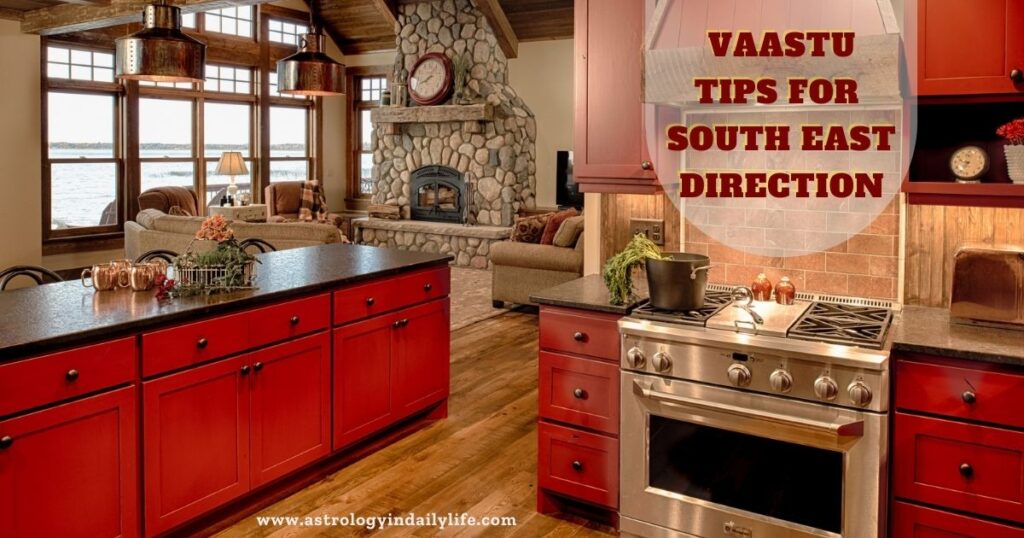
Vaastu Tips for South-East Direction VAASTU SHASTRA: Vaastu Shastra evolved during the Vedic period in India. It is a part of the Atharva Veda. Vaastu Shastra is a science as well as an art. It endeavours to harness the energies of the Panch Tatwas viz the five essential elements of nature which play a vital role in architecture and home designing. The basic purpose and principle of Vaastu Shastra are to help human beings live healthy, prosperous and balanced life. VAASTU & ASTROLOGY: Vaastu is one of the important limbs of Vedic Astrology. Just as Astrology considers nine planets; so also there are nine directions in Vaastu. Each planet rules a particular direction. If you visit a Hindu temple, you will notice that idols of the navagrahas ie. the 9 planets are placed facing the directions that they rule. DIRECTIONS IN VAASTU: HERE ARE SOME IMPORTANT VAASTU TIPS RELATED TO THE SOUTH-EAST CORNER OF THE HOUSE: AGNI – THE LORD OF FIRE RULES THE SOUTH-EAST CORNER (आग्नेय कोण). Hence fire and heat energies are prominent in this area. This direction is important for providing energy to the whole household. The South East corner should be lower than the South West corner. It is auspicious to make the dressing room and cosmetics room in this direction. Southeast is the ideal direction to construct kitchens and cooking areas. The kitchen located here improves the financial condition of the person and is also helpful in getting the stagnant money. However one should not have a dining area in this corner. According to Vastu Shastra, this direction is best for works related to fire. In this direction, it is best to have the gas, cooking range, electrical equipment, inverter, hot water furnace and boiler or equipment, related to fire. It is ideal to place ovens, mixer grinders, and other such electric and heat-generating equipment in this corner. Fire and water should not be placed close to each other in the South East corner. Otherwise, there shall be frequent incidents of fire or short-circuit accidents. Do not have boring, tap, handpump and water tank in this direction. An underground water tank located in the southeast direction prevents the positive flow of money and also adversely affects women’s health. There should be no water source or storage or overhead tanks in the South East corner of the house. This may create problems with the tenants. If the South East corner is adversely affected, it may result in skirmishes in domestic life. Do not have bedrooms in this direction. Never put a mirror in the South-East direction. Use a Red bulb in the South-East room if you are using it as a Bedroom. To read tips for VAASTU TIPS for the NORTH direction, click HERE.
INTERESTING VASTU TIPS FOR NORTH-EAST DIRECTION
VAASTU SHASTRA: Vaastu Shastra evolved during the Vedic period in India. It is a part of the Atharva Veda. Vastu Shastra is a science as well as an art. It endeavours to harness the energies of the Panch Tatwas viz the five essential elements of nature which play a vital role in architecture and designing homes and offices. The basic purpose and principle of Vaastu Shastra are to help human beings live healthy, prosperous and balanced life. VAASTU & ASTROLOGY: Undoubtedly, Vaastu is one of the important limbs of Vedic Astrology. Just as Astrology considers nine planets; so also there are nine directions in Vaastu. Each planet rules a particular direction. If you visit a Hindu temple, you will notice the idols of the navagrahas ie. the 9 planets placed facing the directions that they rule. DIRECTIONS IN VAASTU: In Vaastu, there are nine important directions: East, West, North, South, North-East, North-West, South-East, South-West, and the centre, known as Brahma Sthala. Each direction has its meaning and is associated with a specific deity and element. When these five elements are in perfect harmony, life becomes balanced and harmonious. Properly aligning your living space according to Vaastu principles can bring peace, prosperity, and well-being into your life. HERE ARE SOME IMPORTANT VAASTU TIPS RELATED TO THE NORTH-EAST CORNER OF THE HOUSE: JUPITER RULES THE NORTH-EAST (ईशान कोण), while SHIVA is its guardian. The northeast is the direction of Divinity; it is the most sacred corner of a house. No doubt, a Vastu-compliant Northeast Corner ensures peace, harmony and tranquillity in domestic life. It is auspicious to have the main door or main gate of the house in the Northeast direction. This is the best corner to have a personal place of worship/meditation or a small family temple. It is propitious to have big and wide windows on the North-Eastern wall. The North-East corner should be kept very neat and clean. Avoid all clutter here. Sweep the floor with salt water at least thrice a week. Ideally, the North-East corner is more suitable for children and senior citizens. Married couples should avoid their bedroom here. One can also have a study room or a living room here. Having a big hall or verandah in the northeast gives very auspicious results. Do not keep heavy articles in the North-East corner of the house nor crowd this area. This may cause your children to lose their interest in studies. It results in the restlessness of the mind Unmarried girls should not sleep in a bedroom located in the North-East corner of the house; it may delay their marriage. They may have to face health problems too. Do not construct toilets in this corner. This may result in extreme misery and misfortune. Containers or pots of drinking water and water filters should ideally be placed in the North-East corner. Keeping clay articles in this direction helps get rid of various problems. Keeping herbs or medicines in the Northeast side of the house enhances their efficacy and potency. The Northeast direction is the most sacred, so one can also have a place of worship, a puja room here. In fact, meditation, yoga or spiritual activities should be done here. To read VAASTU TIPS in the SOUTH-WEST direction, click HERE.